
Coming Soon: Digital Defiance In A Surveilled World

The Compliance Score
I’m excited to share the opening chapter from my upcoming book, Digital Defiance In A Surveilled World, a collection that blends near-future fiction with focused discussions on digital freedom, privacy, and the technologies of resistance.
The story below, “The Compliance Score,” takes place in Eleutheria; a gleaming, technologically advanced city-state where everyone is under constant surveillance, every action is tracked, every choice is scored, and freedom has been redefined to mean its opposite. Through Maya Chen’s eyes, we experience a single day in a world where surveillance masquerades as transparency, control poses as harmony, and the architecture itself has become a cage.
Due for release on March the 31st 2026, this book is for anyone who’s ever felt uneasy about the trade-offs we’re making, who senses that something essential is being lost in our rush toward algorithmic optimization, and who’s looking for both philosophical grounding and practical pathways toward genuine digital freedom.
Read on for a glimpse of Maya’s journey and perhaps, a mirror for our own.
Prologue: The Compliance Score
The apartment knew Maya was awake before she did.
The circadian algorithm had been tracking her REM cycles through the mattress sensors, and at 6:47 AM, three minutes before optimal wake time, the blackout curtains began their gradual brightening sequence. The kitchen started heating water to exactly 96°C for her green tea. The bathroom mirror displayed her overnight health metrics in soft blue light: heart rate variability slightly elevated, possibly stress-related. A gentle suggestion appeared to try the new guided meditation app, pre-approved by her employer’s wellness program.
Maya Chen lay still for a moment, eyes closed, pretending she could ignore it all. Pretending she lived in a time when morning was still her own. Her phone chimed. Not the gentle chime. The administrative one.
Compliance Reminder: Social Harmony Score currently 847. Daily commute departure window optimal at 7:23-7:31 AM to maintain punctuality metrics. Your cooperation builds a better Eleutheria.
847?! She’d been 851 yesterday. Four points lost, probably from that comment she’d made at dinner with Zhao about the new traffic management system. Not even a real complaint, just an observation that the routes seemed to take longer now, but Zhao’s phone had been on the table. They were always on the table.
She opened her eyes. The ceiling display showed her schedule: Team synchronization meeting at 9 AM, lunch with a client at the pre-approved restaurant (the system had already ordered her usual low-sodium option), three project check-ins, and a reminder to submit her quarterly civic participation report. Below that, a small yellow notification: Financial Wellness Alert: Unnecessary Purchase Pattern Detected.
Maya’s stomach tightened. The coffee yesterday. The real coffee from the small shop on Prosperity Avenue, not the approved beverage from the campus cafeteria. She’d paid with her digital currency wallet, of course, cash transactions triggered immediate inquiries now, and somewhere in the Eleutherian Ministry of Social Harmony’s data centers, an algorithm had noted the deviation.
Unnecessary. The word sat in her chest like a stone. She got up, went through her morning routine under the bathroom camera’s discreet observation (mandatory in all new construction, for safety and freedom purposes, the housing authority had explained), and dressed in one of her three work-appropriate outfits. The mirror’s AI complimented her choice and noted that her posture suggested tension. Perhaps she should book a session with her assigned wellness counselor?
Maya declined, already knowing it would cost her a fraction of a point. Declining suggestions always did. The system called it “optimization resistance,” which sounded so much gentler than what it was.
The subway platform was precisely as crowded as the system had predicted. Maya stood in her designated waiting zone, marked by a subtle green square that only appeared through her AR glasses, and watched the other commuters. Everyone had the same careful expression. Not quite smiling, not quite neutral. The look of people who knew they were being optimized.
Above the platform, a digital banner cycled through morning messages: ELEUTHERIA: 127 YEARS OF FREEDOM FROM CHAOS. Then: YOUR CHOICES SHAPE OUR SHARED LIBERTY. Then: TRANSPARENCY IS TRUST. TRUST IS FREEDOM.
Maya had memorized them all. The city-state had been founded by refugees, or so the official history taught. People fleeing the collapse of the old nations, seeking a place where technology could liberate humanity from its worst impulses. Where algorithms could free people from bias, from corruption, from the tyranny of uncertain outcomes. The Founding Charter, displayed in the Freedom Museum in Liberation Square, promised “a society where every citizen is free to flourish within a framework of collective optimization.”
Her grandmother had lived through the transition. She’d been eighteen when the last election was held, before the Council of Prosperity proved mathematically that representative democracy was inefficient and that algorithmic governance would “liberate citizens from the burden of political choice.” Grandmother had called it something else, before she’d stopped talking about it entirely.
Before she’d learned to say “freedom” the way everyone else did. The train arrived exactly on schedule. It always did now.
Maya found a seat between a man reading state-approved news on his tablet and a woman whose lips moved silently, possibly praying, possibly just talking to herself in the only way that couldn’t be transcribed. The woman’s wrist showed the telltale green band of someone in the 920+ score range. Exemplary citizen. Maya had been there once, two years ago, before she’d started noticing things.
Before she’d started asking questions she wasn’t supposed to ask.
The train slid through tunnels lined with advertisements that shifted based on who was watching. Maya saw ads for productivity software, ergonomic office furniture, and a new smart-home integration system that promised to “harmonize your living space with your life goals.” The man next to her was probably seeing investment opportunities and luxury goods. The woman with the green band might be seeing volunteer opportunities and civic achievement awards.
The system knew exactly what everyone needed to see. That’s what freedom meant now; being shown exactly what you needed, when you needed it, whether you knew you needed it or not.
At Liberation Square station, Maya noticed the disruption before the official announcement came. People ahead weren’t moving. A delay. Rare enough to be noteworthy. The algorithm didn’t like delays.
“Technical difficulties,” the announcement said in English, then Mandarin, then Arabic, then Russian, then a dozen other languages. Eleutheria prided itself on its multiculturalism, on being a beacon of post-national unity. “Estimated resolution: eight minutes. We apologize for this departure from expected service excellence. Freedom flows through cooperation.”
Eight minutes. Maya felt the calculation happening across everyone’s phones. Eight minutes late would affect punctuality scores. Depending on your current standing, that could mean anything from a fractional point deduction to being flagged for workplace review. She opened her own phone and saw the automated excuse already generated and sent to her employer: Transportation disruption, verified by municipal systems. Employee not at fault.
Not at fault. But still not quite blameless.
The train jerked forward after eleven minutes, not eight. Maya watched three people around her visibly anxious, checking their scores. One woman was already composing what looked like an appeal to her supervisor, fingers flying across her phone screen.
When Maya emerged from the subway at the Financial District hub, she had six minutes to make a nine-minute walk. She speed-walked past the Freedom Tower, the gleaming spire that housed the Ministry of Social Harmony’s central servers, her phone’s GPS tracking every step, her heart rate climbing into the yellow zone.
She arrived at 9:04. Four minutes late. The office entry system logged it with a soft beep that sounded almost apologetic. A small message appeared on the turnstile screen: We believe in your commitment to optimal contribution. Tomorrow is a new opportunity for excellence.
Her desk display showed her updated score before she’d even sat down, 843.
Four more points, gone.
The client lunch was a performance, and everyone knew their lines.
Mr. Zhang from the property development company smiled with teeth that had cost more than Maya made in six months. His score would be in the high 900s, men like him always were. The system loved money almost as much as it loved obedience, and Zhang had both. He wore a small silver pin on his lapel, the Eleutherian sunburst, awarded to citizens who’d maintained scores above 950 for five consecutive years.
“Your firm’s architectural projections are innovative,” he said, lifting his cup of tea in a gesture that the restaurant’s ambient cameras would log as collegial engagement. “We appreciate how you’ve incorporated the new civic wellness centers into the residential design. Very aligned with Eleutherian values.”
Civic wellness centers. That’s what they called the neighborhood monitoring stations now. Every new development required one per ten thousand residents, positioned according to optimal sight-line algorithms. Maya had drawn seventeen of them in the past year, small buildings with large windows and discreet antenna arrays, where citizens could walk in for everything from blood pressure checks to loyalty verification. The official brochures called them “Freedom Houses”, places where residents could access their rights and responsibilities.
She smiled her professional smile. “We’re honored to support community harmony. The centers integrate seamlessly with the residential flow while maintaining the transparency principles that define Eleutherian architecture.”
Transparency. Another word that had changed. In the early days, the Founders had promised a transparent government, citizens able to see how power operated. Somehow, over twelve decades, transparency had flipped. Now the government was opaque, protected by “security protocols” and “optimization confidentiality.” But the citizens? They were transparent. Completely. The Transparency Act of 2087 had made it official: “A free society requires that liberty and accountability flow together. Citizens have nothing to fear from clarity.”
The words tasted like ash, but they came easily now. She’d been practicing for two years.
They ordered, or rather, the restaurant’s AI ordered for them based on their dietary profiles, past preferences, and current health metrics. Maya’s meal arrived with a small flag on a toothpick: a green leaf, indicating optimal nutrition density. Zhang’s had a small golden star. Premium tier. Different nutritional algorithms for different social strata.
Halfway through the meal, Zhang leaned back and said something that made Maya’s pulse spike.
“I hear you used to write.” His tone was casual, but nothing was casual anymore. “Poetry, wasn’t it? Back in university?”
Maya’s hand tightened on her chopsticks. “A long time ago.”
“Shame you stopped. The city needs more culture. More beauty. Did you know the Founding Mothers wrote poetry? Part of the original vision, freedom of expression as the foundation for a flourishing society.” He paused, and in that pause, Maya heard the unspoken question: Why did you stop?
Well, three of her classmates from the poetry circle had vanished into rural reassignment programs after publishing work that “promoted disharmony through ambiguous metaphor.” Her professor had also been dismissed for “encouraging unproductive intellectual pursuits that diverted students from optimization pathways”, and because the last poem Maya had written; about a bird in a cage that couldn’t remember sky. had earned her a visit from a civic harmony coordinator who’d explained, very kindly, that some metaphors were unhelpful.
That freedom meant knowing which thoughts to keep to yourself.
“Life gets busy,” Maya said.
Zhang nodded slowly. “It does. But perhaps not too busy for beauty, yes? My daughter writes. I’ll send you some of her work. Approved for publication, all of it. Very talented. She writes about freedom, mostly. The way Eleutheria freed her generation from the mistakes of the past.”
A warning wrapped in a compliment wrapped in a threat. Or maybe just a father’s pride. It was getting harder to tell the difference.
Her phone buzzed softly. A microtransaction notification: 0.3 points deposited to her social harmony score. The system had analyzed the lunch conversation through the restaurant’s audio pickups and determined that she’d contributed positively to business relations and cultural exchange.
She’d gained back some of what the coffee had cost her.
The afternoon dissolved into meetings and messages, all of which were logged and analyzed by Eleutheria’s system. Maya worked on a residential complex design, dragging windows and walls around a screen while knowing that every choice was being evaluated. Balcony sizes that enabled but didn’t encourage extended outdoor gatherings. Courtyards with clear sightlines. Smart glass that could become opaque on command, but whose opacity could be overridden by authorized personnel “in cases of emergency or civic necessity.”
Architecture had become applied behavioral economics, and Maya had become very good at it. Good enough that her score had stayed mostly stable in the 840s for eighteen months. Good enough that she’d stopped designing buildings that helped people and started designing buildings that managed them.
She pulled up the project notes for the new development in the Founders’ District. The site was historically significant, supposedly where the original refugees had first landed, fleeing the chaos of the collapsed nation-states. The memorial there read: HERE WE FOUND FREEDOM. HERE WE BUILD FREEDOM. HERE FREEDOM MEANS TOMORROW.
Maya had asked her grandmother once what the city had been like in those early days. Grandmother had looked out the window for a long time before answering.
“We thought we were building something different,” she’d finally said. “A city where technology would serve us, not rule us. Where we’d be free to choose our own paths.” She’d paused. “But every freedom we gave up, we gave up for safety. For efficiency. For the good of everyone. They asked nicely. We said yes. And one day we woke up and realized we’d said yes to everything.”
At 5:47 PM, three minutes before optimal departure time, Maya shut down her workstation and headed for the exit. Her colleague Wei fell into step beside her, also heading out, also right on schedule. They’d never explicitly coordinated their departure times, but the algorithm nudged everyone toward the same narrow windows of acceptable behavior.
“Weekend plans?” Wei asked as they waited for the elevator.
“Grocery shopping. Laundry. Maybe a walk along the Promenade.”
“Sounds nice.” Wei’s tone was flat. The Promenade walk was on everyone’s weekend schedule these days. The city had launched an initiative to encourage “outdoor social harmony,” and the riverside walkway had cameras every fifteen meters. Walking there was worth 0.1 points per hour, up to a maximum of 0.5 points per weekend. The initiative was called “Freedom Paths”, encouraging citizens to choose their own route while the system tracked every step.
They rode down in silence, surrounded by other colleagues whose faces showed the same careful emptiness. The elevator music was a string quartet version of the Eleutherian anthem. Someone had done a study showing that patriotic music made people more compliant during transitions.
Maya stepped out into the September heat and immediately felt her phone buzz with the evening’s suggested route home. It would take her past three state-operated shops where her purchasing history indicated she might need to restock household items. It would take exactly thirty-one minutes, which was optimal for her step count goals without being excessive. It would avoid the stretch of Prosperity Avenue where an unlicensed street market had been operating for the past week, because the system knew she’d stopped there twice last month.
She started walking the suggested route. Six steps. Twelve steps. Eighteen.
At twenty-four steps, Maya stopped.
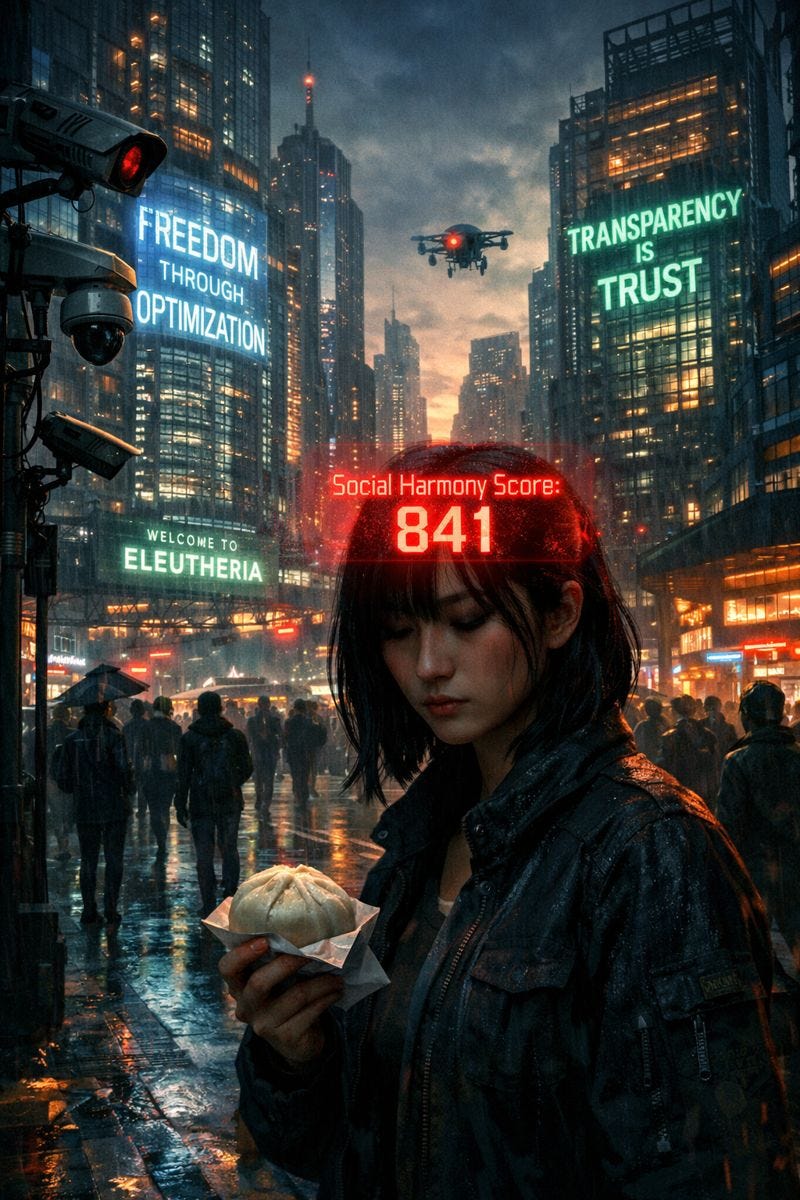
Across the street, in a small plaza that wasn’t on her route, stood something she hadn’t seen in months. A man selling steamed buns from a cart. Not a registered vendor. No QR code for payment. Just an old man with a bamboo steamer and a small sign in hand-brushed characters: Three dollars. Cash only.
Cash. Maya hadn’t held cash in fourteen months. Digital currency transactions were mandatory for all but the most trivial exchanges, and even those were being phased out. The Cashless Liberty Act of 2103 had made it official: “True freedom requires financial transparency. Cash enables shadows. Light enables trust.”
Using cash was technically legal but practically suspicious. It left no record. It couldn’t be optimized, analyzed, or rewarded.
It was invisible to the algorithm.
Maya watched three people walk past the cart without stopping. Their routes probably didn’t include this plaza. Their profiles probably didn’t match the vendor’s product offering. The system was steering them away as efficiently as it steered her toward the approved shopping district.
She thought about her score. 843. Not terrible. Not good. Right on the edge of where restrictions began; travel permit processing slowed down, loan approvals required additional review, promotions became unlikely. Drop below 820 and things got worse. Premium services disappeared. Your children’s school placement options narrowed. Questions got asked. Below 800, you lost access to the Liberty Zones, the upscale districts where the high-scorers lived.
The irony had stopped being funny years ago. Liberty Zones. Freedom Houses. Liberation Square. Eleutheria itself, the name meant freedom in ancient Greek, a language most citizens didn’t know, but Maya had looked it up once, in a moment of curiosity that probably cost her a fraction of a point for “atypical search patterns.”
The city-state that promised freedom had made freedom mean its opposite.
Maya’s phone buzzed. Route deviation detected. Suggested path available to resume optimal journey. Remember: Your choices create our shared tomorrow.
She looked at the old man. He looked back with the wariness of someone who knew that every customer was a risk. Someone who’d probably already been warned, already been fined, already been told that his cart and his buns and his refusal to integrate into the payment system were “disrupting commercial harmony and limiting his own freedom to participate in Eleutherian prosperity.”
Someone who was doing it anyway.
Maya reached into her bag and found the small emergency cash she kept for reasons she’d never quite articulated to herself. A fifty dollar note, creased and soft. She walked to the cart.
“One bun, please.”
The old man’s eyebrows rose fractionally. His hands were weathered, marked by decades of work that no algorithm had optimized. He wrapped a bun in thin paper and handed it to her, then made change from a small metal box. The transaction took fifteen seconds. No chime, no confirmation, no data point added to her consumer profile.
For fifteen seconds, Maya Chen had made a choice that no algorithm could see.
The bun was still warm in her hand when her phone buzzed again. Unusual stop detected. Please confirm: Are you experiencing a health emergency requiring assistance?
“No,” she whispered to the phone, knowing it was listening. “No emergency.”
Route recalculation in progress. Estimated impact to evening schedule: negligible. Continue. Your wellbeing is our priority. Freedom means caring for one another.
She walked away from the plaza, eating the bun in small bites. It was good. Not optimally nutritious, probably. Not approved by any dietary algorithm. Just good.
When she checked her score that evening, it had dropped to 841. Two points for the route deviation. Two points for the unrecorded transaction that the cameras had still captured but couldn’t categorize. Two points for choosing steam over data.
Maya stood in her apartment as the smart windows darkened automatically to her preferred evening opacity. She thought about poetry. She thought about birds in cages. She thought about the old man and his cart and the small rebellion of hot bread sold for cash.
And she thought about the message she’d received three days ago, one that had appeared in her personal email and then immediately disappeared, leaving no trace in her inbox. A message she’d convinced herself was spam or a glitch or a trap:
If you’re tired of being free, there’s another way. Not perfect. Not safe. But yours. Find the garden behind the Old Founders’ Monument on Saturday at midnight. Bring only what you can’t replace. Come alone. Real freedom remembers what the word meant.
The Old Founders’ Monument. Maya knew it. A crumbling stone memorial in the Heritage District, mostly forgotten, marking the spot where the first refugees supposedly held their first assembly. The plaque read: HERE WE CHOSE FREEDOM OVER CHAOS. WE CHOSE TOMORROW OVER YESTERDAY. WE CHOSE TOGETHER OVER ALONE.
She’d stood there once, five years ago, and wondered what “chose” had meant to those people. Whether they’d known what they were choosing. Whether they’d imagined a future where “freedom” would mean exactly this: a cage painted in the colors of liberty.
841. The numbers were a story she hadn’t written but had been written about her. A story where someone else held the pen.
Maya opened her closet and reached behind the winter coats she wouldn’t need for months. She pulled out a small waterproof bag she’d packed six months ago, when the score system had expanded to include “emotional wellness metrics” and she’d started having dreams about drowning in green numbers.
Inside the bag was her grandfather’s jade pendant, the last thing she owned that wasn’t catalogued in any database. A portable battery pack. A memory card with photos from before; before the scores, before the optimization, before Eleutheria became what it was now. And three thousand dollars in cash, saved in small amounts over two years, hidden and ignored.
She didn’t know if the message was real. Didn’t know if she’d actually go. Didn’t know what “the garden” meant or what she’d find there, but she knew what the alternative looked like. She’d been designing it for five years, drawing the walls and windows and sightlines of a city that saw everything and forgave nothing. A city that called surveillance “transparency” and called control “harmony” and called itself Eleutheria, freedom, while making sure that no one remembered what freedom actually meant.
Saturday was in three days.
Maya put the bag back in the closet and closed the door. She made tea. She sat on her couch as the apartment’s ambient system played soft music calculated to reduce her stress markers. She watched the city lights through her smart window where millions of data points, millions of lives being tracked and scored and optimized and thought about compliance and defiance and the terrible mathematics of freedom.
Somewhere in a data center beneath Freedom Tower, an algorithm noted her elevated heart rate and flagged it for review. Not urgent. Just a data point. Just another number in the endless story of Maya Chen, whose score was 841 and falling, who was being watched every moment, who had just realized that being seen was not the same as being known.
Who was starting to understand the difference between being free and being told you were free. Who was learning that sometimes the first act of liberation is remembering what the word used to mean…..