

Notes on the Time of the Bedouin – Part 1
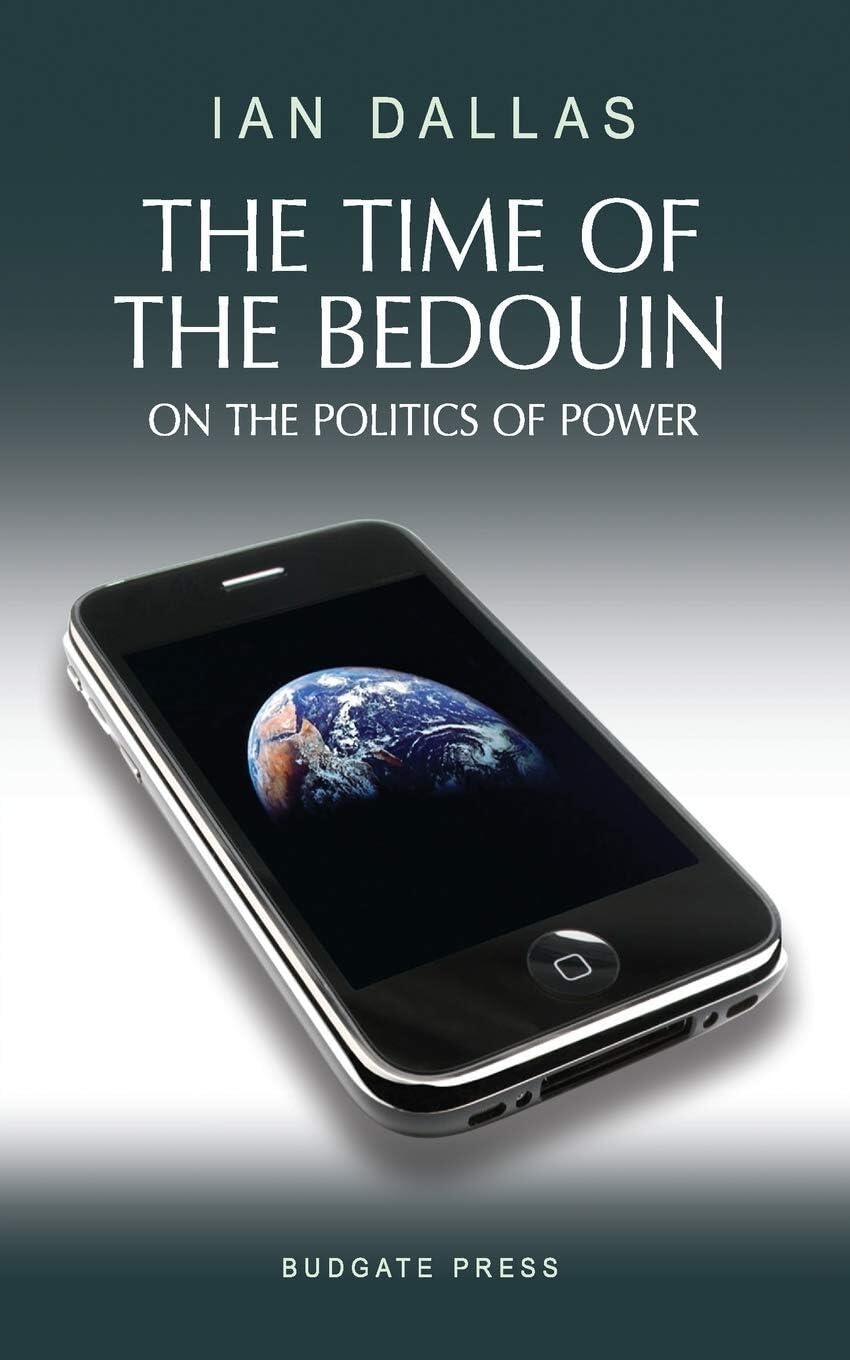
Reading through the last chapter of The Time of the Bedouin has been both fascinating and challenging, because Ian Dallas (Shaykh Abdalqadir As-Sufi) is offering a civilizational diagnosis rather than just a history lesson, and in doing so
Reading through the last chapter of The Time of the Bedouin has been both fascinating and challenging, because Ian Dallas (Shaykh Abdalqadir As-Sufi) is offering a civilizational diagnosis rather than just a history lesson, and in doing so he draws on an entire library of thinkers and philosophers. I find myself having to pause, look things up, and think about the connections he is making, yet the core thread is surprisingly clear once I slow down. Basically, the modern order we live in was born with the French Revolution, an order built on atheism, finance, and structural power rather than religion and kingship. It is, in his terms, the reign of "the Sect," and it is an order now in its death throes.
Dallas begins with a stark claim that:
“With the French Revolution a new social system came into being. Its implications were far-reaching. It was not a French phenomenon but rather took on an apocalyptic and world significance. In the process it abolished monarchy, and with it consigned the concept of monarchy to the dustbin of history.”
This is a pretty bold statement because he doesn’t treat the Revolution as just a national upheaval or a step in a timeline of liberal progress, but rather he frames it as the apocalyptic moment when religion was stripped from its public role:
“Religion was redefined as ‘belief’ and in turn consigned to the dustbin of the Unconscious”
Monarchy was liquidated, inheritance was disrupted, and even womanhood itself was symbolically executed with Marie-Antoinette. In his view, the Revolution cut the cords that bound society to its past, and what rose in its place was a “headless structuralist State” whose true inner necessity and structure was atheism.
This “headless” State had a permanent bureaucracy of police and army, but the real story is that over the course of the nineteenth century, the political class was gradually consumed by the banking class, a piece of history that many bitcoiners deep in the rabbit hole are familiar with. From the assignats of the Revolution to the emergence of the great financial dynasties, Dallas says that:
“the banking class, slowly, step by step emerged from the evolutionary swamps of ‘modernity’, finally to dominate the landscape, carnivorous monsters ready to devour the herbivorous talking-class of the Legislators.”
The point here is that politics became the theater, while finance became the substance, and it was finance that ultimately devoured kings, parliament, governments, and even nations states.
To make sense of this collapse of meaning, Dallas turns to two composers, Wagner and Ibsen (of course I'm culturally illiterate so I had to look these up). Dallas says that Wagner’s Ring Cycle is interpreted as an allegory for financialization. The gods’ power no longer rests in their warrior-class but in their possession of the Ring, forged from gold but more potent than gold itself:
“The gold in the cave, real capital, is never used. The Ring, the magical dimension of gold, is enough to give power. The function of power is increase. Increase in the transaction is usury itself.”
This is an extraordinary way of framing it because the Arabic word Riba means an "increase." Basically, real capital sits unused, while the abstract instrument of the claim (the Ring) is what grants power, just as credit and paper dominate real resources in our modern economy. Yet Wagner does not leave it in despair as he describes the emergence of the fearless hero Siegfried and the warrior woman Brünnhilde, whose return of the Ring to the Rhine signifies a re-naturalization of wealth and a purging of the gods’ corrupt order.
The Norwegian playwright Henrik Ibsen, meanwhile, presents the nihilism of the bourgeois order through his tragedies, and Dallas gives examples of his plays that include suicides, avalanches, and shattered households.
Ibsen’s world is suffocating, but like Wagner’s it ends with the possibility of redemption through the couple, through the uniting of man and woman against the void. It should be mentioned that Dallas stresses that the Revolution was fundamentally misogynistic as it abolished “woman” alongside monarchy, and so any future order, any “new Nomos,” must be grounded in what he calls the “liberating couple" or the male and female joined in a sacrificial and creative project for mankind.
Anyway, the next thing that Dallas talks about in this section is terrorism as the expression of a dying order, where terror is endogenous to the collapsing system. He outlines its cycle: terrorists and regime belong to the same social body -> terror rebounds against society -> the state suppresses both terrorists and people under draconian security laws -> the state begins to manufacture terror itself in order to justify its existence. At that point, he says:
“the State is structurally doomed. The terrorists did not do it, since they are no more. The State has committed suicide.”
It becomes clear that terrorism, nihilism, and suicide are essentially the same thing for Dallas, all symptoms of a collapsing order that can no longer sustain itself.
It is here that he brings in Ibn Khaldun, and this was perhaps the most illuminating section for me. Ibn Khaldun described three stages: the Bedouin, ʼasabiyya, and kingship. The Bedouin are not just nomads but outsiders to the urban and settled order. In modern terms, they might be the marginalized districts or those who remain unassimilated by the dominant system. Out of them emerges ʼasabiyya, which Ibn Khaldun defines as a unifying solidarity that transcends blood ties, a "group feeling" or a moral brotherhood with the force to act, transform, and command. Dallas explains:
“ ʼAsabiyya unites men to find the power to act and transform and command. If its motor power is high, its brotherhood is raised higher. If the binding factor (religio — to bind together) is there, that is Divine religion, it is, that being its highest possibility, assured a triumph.”
And finally, ʼasabiyya eventually culminates in kingship, or the personal rule legitimized by oath and allegiance. This model stands as the complete opposite of the headless and bureaucratic State of the Sect, where it literally cannot form ʼasabiyya because its very system mathematically ensures the concentration of wealth into fewer and fewer hands, and it even breeds hostility among its own elites. Dallas does not mention this but I am reminded of the relevant Quran verse in Surah Al-Hashr verse 14:
"They will not fight you (even) together, except in fortified townships, or from behind walls. Strong is their fighting (spirit) amongst themselves: thou wouldst think they were united, but their hearts are divided: that is because they are a people devoid of wisdom." (A. Yusuf Ali translation)
So the Sect has no true bond but only instruments of control. The new Bedouin, by contrast, have the capacity to forge a living bond animated by Divine religion, to appoint leadership by oath, and to re-establish personal authority.
From there, Dallas brings in four twentieth-century thinkers, Heisenberg, Heidegger, Jünger, and Schmitt, each of whom, in his view, represents a guardian at the threshold of a new order. We need to pause here and explain how and what Dallas is getting at.
Each one comes from a different field (science, philosophy, literature, law) and each in their own way declared that the old bourgeois/finance-driven order was finished.
Heisenberg, as the scientist, shattered the old Newtonian worldview. Instead of a clockwork universe with solid atoms like billiard balls, reality is now understood as particles and waves, and as probability. The modern political/economic order is built on rigid rationalism (like Newton’s mechanics). Heisenberg symbolizes a dynamic and paradoxical, or “fuzzy” cosmos, which means the future can’t be governed by fixed Enlightenment categories. Renewal requires thinking in living and changing terms rather than old static systems.
Martin Heidegger, as the philosopher, "extricated the human creature in an event of such distinctive character he felt obliged to rename man ‘Dasein... What he had done was nothing less than cast aside the image of man as the enslaved end-product of unconfronted functionality and passivity. He replaced it with a view of man as a project-oriented being, active and engaged in encountering his meanings and his mortality. So what Heidegger opened up for the future was nothing less than the phenomenology of freedom, which by implication, laid bare the mechanisms of slavery which made peace look like war, made legislated liberty produce slave camps, abstract research produce nuclear weaponry, and psychotherapy produce passive consumers.” He essentially redefined man as free and responsible, and Dallas sees him as offering a path out of the structural State’s machinery and reclaim freedom through conscious and lived existence.
Ernst Jünger, as the visionary, reframed “the worker” not as a Marxist proletariat but as basically all of us, since we all now exist under the total system of technique. He gave this condition a mythic name as the "Gestalt of the Worker" or the archetypal form that defines modern man. He declared bourgeois society “condemned to death” but he also warned that society keeps itself alive by simulating attacks against itself (which eerily anticipates today’s cycle of manufactured crises and terror). For Dallas, Jünger helps us both diagnose nihilism and think about survival and ultimate victory through (but not outside of) technique.
Lastly, Carl Schmitt, as the legalist, puts it bluntly: “The State, the model of political unity, which embodied the monopoly of political decision, the State, this work of art, made in a European mould and with Western rationalism, is dethroned.” Politics (real decision-making about enemies) has collapsed into police (administration, security, bureaucracy). The system no longer recognizes enemies as human beings, but as inhuman criminals. This logic of de-humanization basically explains the genocide, torture, and endless “wars on terror.” Once people let themselves be defined as “the International Community,” they’ve already surrendered politics. Schmitt shows the financial-police State’s final form is total depoliticization and inhumane absolutism.
In short, when looking at these 4, their common contribution is to declare that bourgeois society is finished and that a new beginning is possible if we can see through the illusions of technique, finance, and the police-state. These 4 giants are the "unique guards at the abandoned gateway to the future."
The picture Dallas paints is dark but strangely hopeful. Dark, because he insists that nihilism, suicide, terrorism, and dehumanization are not accidental aberrations but the logical fulfillment of the revolutionary order that replaced monarchy with finance and inheritance with credit and banking. Hopeful because in Ibn Khaldun’s sociology we can see the grammar of renewal through the return of religion as binding, the formation of ʼasabiyya as solidarity, and the appointment of personal kingship to crown unity with authority.
In the next part, we'll cover the last several pages of the book, where we'll see how a new order and a living ʿasabiyya can be formed and how it can be implemented.