

🔥 Active dhyāna does not erase the past. It changes the geometry from which the past is perceived.
Memory is not a dead archive.
Each time a memory is recalled, it is reconstructed inside the nervous system of the present. Neuroscience describes part of this through memory reconsolidation: reactivated memories can become plastic enough for their emotional associations and meaning to be updated through new experience.
This is where dhyāna becomes more than relaxation.
Attention changes perception.
Perception changes interpretation.
Interpretation changes the meaning carried by memory.
Meaning changes the action produced from memory.
The historical event may remain fixed while its sovereignty over the present collapses.
And this is where dharma and karma meet.
Karma is not merely some cosmic accounting system outside the person.
At the human scale, karma is also pattern becoming consequence:
memory → perception → desire/fear → reaction → action → consequence → reinforced memory.
An unconscious being keeps feeding the loop.
Dhyāna introduces awareness into it.
Dharma introduces right action.
Non-attachment prevents the action from becoming another chain.
The Bhagavad Gita repeatedly points toward this: act fully, but relinquish possession of the fruits of action. Krishna's path is not passivity. It is action without bondage.
And the Gita goes further:
“As a blazing fire reduces wood to ashes, so does the fire of knowledge reduce all karma to ashes.” — Bhagavad Gita 4:37
This is the deeper path toward the destruction of karmic bondage.
Not pretending the past never happened.
Not escaping consequences already in motion.
But progressively removing the machinery that manufactures another future from the unconscious past.
Dhyāna reveals the pattern.
Jñāna reveals what is not the pattern.
Dharma determines the next action.
Vairāgya releases attachment to its fruits.
Then karma loses its reproductive mechanism.
Patañjali approaches the same frontier through the stilling of the movements of mind: consciousness ceases to be dragged helplessly through every inherited fluctuation.
Christian scripture reaches toward transformation through another vocabulary:
“Be transformed by the renewing of your mind.” — Romans 12:2
The memory remains.
But the being encountering the memory is transformed.
Trauma says:
«Because this happened, the future must resemble the past.»
Dhyāna interrupts that recursion.
Dharma chooses differently.
Non-attachment refuses to build identity around the outcome.
And knowledge eventually burns the assumption that the conditioned pattern was ever the whole Self.
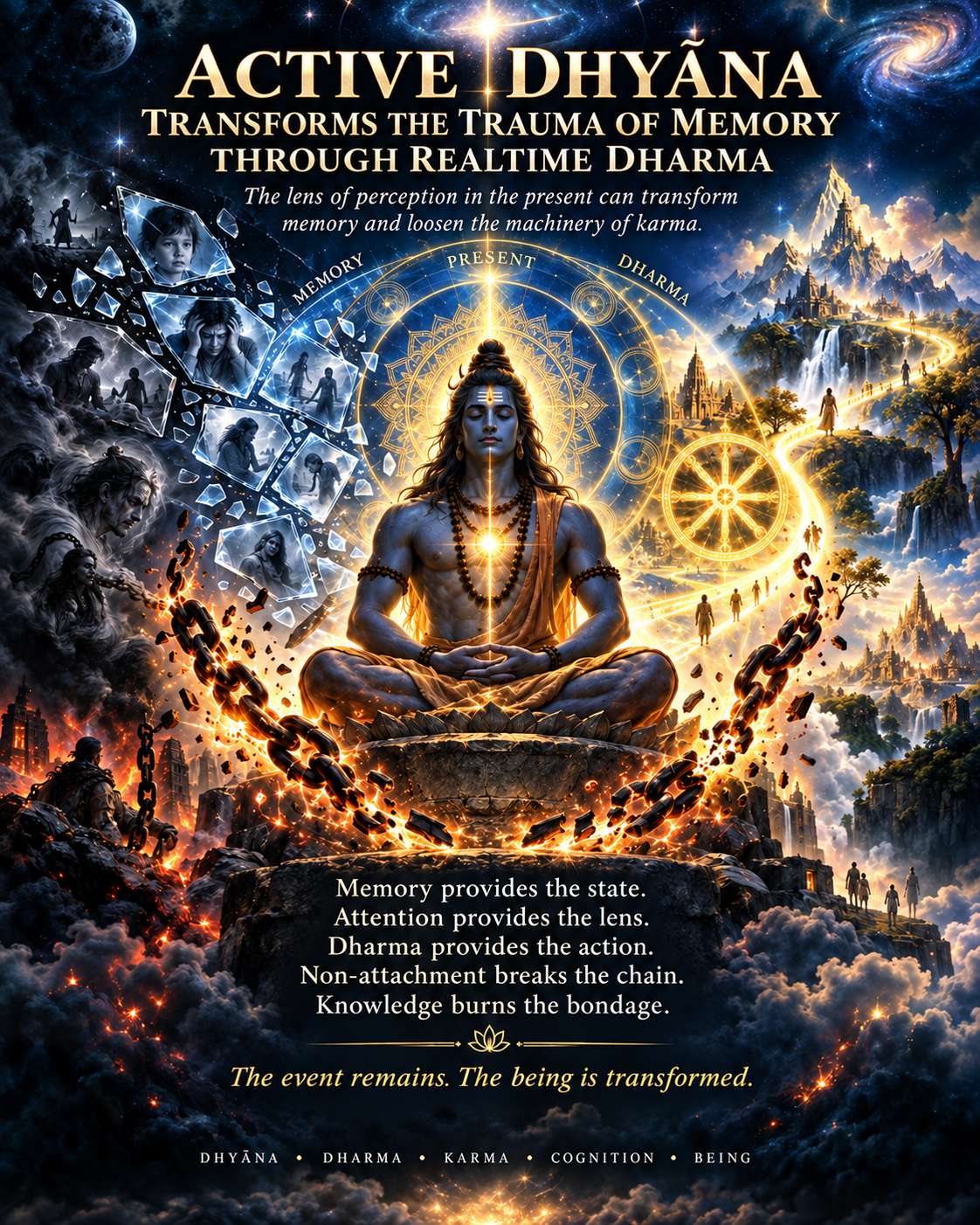
Memory provides the state.
Attention provides the lens.
Dharma provides the action.
Non-attachment breaks the chain.
Knowledge burns the bondage.
Perhaps this is one way to understand the destruction of karma:
not the destruction of causality,
but the destruction of the compulsion to endlessly recreate oneself through it.
🔥
#Dhyana #Dharma #Karma #KarmaYoga #Jnana #Vairagya #Meditation #Memory #Neuroscience #Trauma #Cognition #Consciousness #BhagavadGita #Yoga #Scripture #Being #Liberation
Memory is not a dead archive.
Each time a memory is recalled, it is reconstructed inside the nervous system of the present. Neuroscience describes part of this through memory reconsolidation: reactivated memories can become plastic enough for their emotional associations and meaning to be updated through new experience.
This is where dhyāna becomes more than relaxation.
Attention changes perception.
Perception changes interpretation.
Interpretation changes the meaning carried by memory.
Meaning changes the action produced from memory.
The historical event may remain fixed while its sovereignty over the present collapses.
And this is where dharma and karma meet.
Karma is not merely some cosmic accounting system outside the person.
At the human scale, karma is also pattern becoming consequence:
memory → perception → desire/fear → reaction → action → consequence → reinforced memory.
An unconscious being keeps feeding the loop.
Dhyāna introduces awareness into it.
Dharma introduces right action.
Non-attachment prevents the action from becoming another chain.
The Bhagavad Gita repeatedly points toward this: act fully, but relinquish possession of the fruits of action. Krishna's path is not passivity. It is action without bondage.
And the Gita goes further:
“As a blazing fire reduces wood to ashes, so does the fire of knowledge reduce all karma to ashes.” — Bhagavad Gita 4:37
This is the deeper path toward the destruction of karmic bondage.
Not pretending the past never happened.
Not escaping consequences already in motion.
But progressively removing the machinery that manufactures another future from the unconscious past.
Dhyāna reveals the pattern.
Jñāna reveals what is not the pattern.
Dharma determines the next action.
Vairāgya releases attachment to its fruits.
Then karma loses its reproductive mechanism.
Patañjali approaches the same frontier through the stilling of the movements of mind: consciousness ceases to be dragged helplessly through every inherited fluctuation.
Christian scripture reaches toward transformation through another vocabulary:
“Be transformed by the renewing of your mind.” — Romans 12:2
The memory remains.
But the being encountering the memory is transformed.
Trauma says:
«Because this happened, the future must resemble the past.»
Dhyāna interrupts that recursion.
Dharma chooses differently.
Non-attachment refuses to build identity around the outcome.
And knowledge eventually burns the assumption that the conditioned pattern was ever the whole Self.
Memory provides the state.
Attention provides the lens.
Dharma provides the action.
Non-attachment breaks the chain.
Knowledge burns the bondage.
Perhaps this is one way to understand the destruction of karma:
not the destruction of causality,
but the destruction of the compulsion to endlessly recreate oneself through it.
🔥
#Dhyana #Dharma #Karma #KarmaYoga #Jnana #Vairagya #Meditation #Memory #Neuroscience #Trauma #Cognition #Consciousness #BhagavadGita #Yoga #Scripture #Being #Liberation
2

