

The fascinating exception in the BIP-110 story is this:
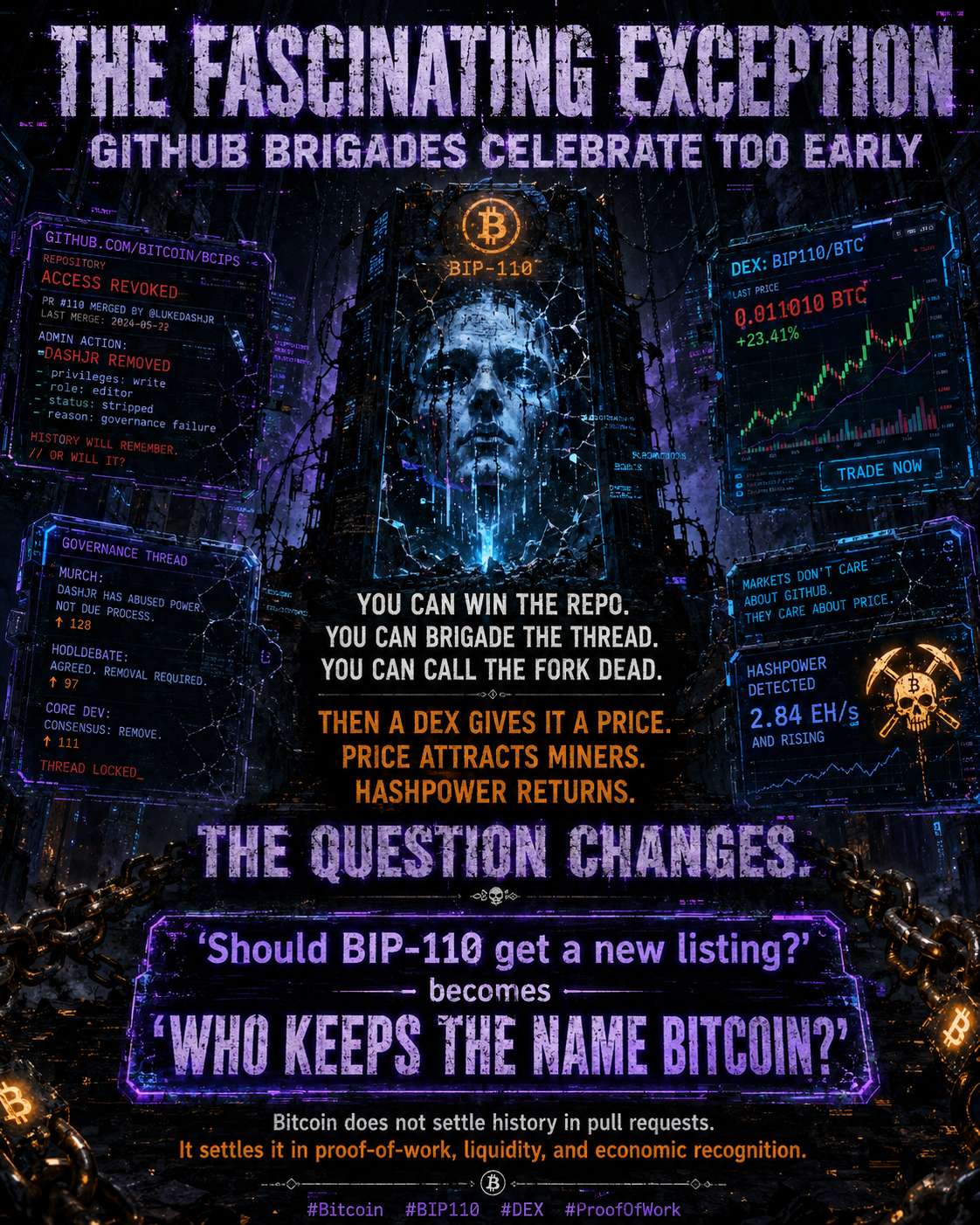
It may not need a new listing forever.
BIP-110 was designed as a soft fork. Its blocks remain valid to older nodes because its rules are stricter, not incompatible.
So if the BIP-110 branch somehow returned with enough hashpower to accumulate more proof-of-work than the current chain, ordinary non-BIP-110 nodes could theoretically reorganize onto it.
That is where the whole story escapes the narrow imagination of GitHub brigades.
Because the shortsighted view is:
“Win the repo.
Win the vote.
Win the social pile-on.
Fork dies.”
But that only describes one layer.
A DEX changes the equation.
If a forked asset begins trading permissionlessly, it can discover a price before centralized exchanges bless it.
If it discovers a price, it can attract speculation.
If it attracts speculation, it can fund miners.
If miners return, blocks return.
If work returns, the “dead fork” stops looking dead.
Then exchanges are no longer just deciding whether to add a novelty listing.
They are forced into the deeper question:
Which chain does our BTC infrastructure now recognize as Bitcoin?
That is the fascinating exception.
GitHub brigades think history is written by maintainers.
But Bitcoin does not settle history in pull requests.
It settles history in the collision between:
proof-of-work
market liquidity
DEX price discovery
exchange policy
and economic recognition.
So the real shortsightedness is mistaking social victory for final victory.
You can remove a man from the repository.
You can brigade the discussion.
You can celebrate the optics.
Then a market forms.
A DEX gives the fork a price.
Hashpower follows price.
And suddenly the question is no longer:
“Should we list BIP-110?”
It becomes:
“Who gets to keep the name Bitcoin?”
#Bitcoin #BIP110 #DEX #ProofOfWork #EconomicConsensus #BitcoinCore #Decentralisation #GitHub
It may not need a new listing forever.
BIP-110 was designed as a soft fork. Its blocks remain valid to older nodes because its rules are stricter, not incompatible.
So if the BIP-110 branch somehow returned with enough hashpower to accumulate more proof-of-work than the current chain, ordinary non-BIP-110 nodes could theoretically reorganize onto it.
That is where the whole story escapes the narrow imagination of GitHub brigades.
Because the shortsighted view is:
“Win the repo.
Win the vote.
Win the social pile-on.
Fork dies.”
But that only describes one layer.
A DEX changes the equation.
If a forked asset begins trading permissionlessly, it can discover a price before centralized exchanges bless it.
If it discovers a price, it can attract speculation.
If it attracts speculation, it can fund miners.
If miners return, blocks return.
If work returns, the “dead fork” stops looking dead.
Then exchanges are no longer just deciding whether to add a novelty listing.
They are forced into the deeper question:
Which chain does our BTC infrastructure now recognize as Bitcoin?
That is the fascinating exception.
GitHub brigades think history is written by maintainers.
But Bitcoin does not settle history in pull requests.
It settles history in the collision between:
proof-of-work
market liquidity
DEX price discovery
exchange policy
and economic recognition.
So the real shortsightedness is mistaking social victory for final victory.
You can remove a man from the repository.
You can brigade the discussion.
You can celebrate the optics.
Then a market forms.
A DEX gives the fork a price.
Hashpower follows price.
And suddenly the question is no longer:
“Should we list BIP-110?”
It becomes:
“Who gets to keep the name Bitcoin?”
#Bitcoin #BIP110 #DEX #ProofOfWork #EconomicConsensus #BitcoinCore #Decentralisation #GitHub
3❤️1👍1
