There was a viral joke recently about the 3 largest cities in Germany all lying on a circle … but whether that made you laugh or groan, it gives me an excuse to mention 3 non-trivial things about the circle through 3 points on 3 kinds of surface.
[1] If you pick 3 points at random on a unit sphere, what is the average radius (measured along the surface) of the circle they define?
If we integrate from r=0 to π/2:
Mean(r) = ∫ r sin³r dr / ∫ sin³r dr
= 7/6
[2] What happens on a flat surface? Here, there is no upper bound on the radius, and it turns out that it grows so high for nearly-colinear points that the average becomes infinite.
[3] For a region in the hyperbolic plane, there is a further twist: sometimes 3 points *don't* lie on any circle, but a different curve known as a hypercycle.
This is easiest to see if we model the hyperbolic plane as one surface of the hyperboloid −𝑡²+𝑥²+𝑦²=−1. The image shows 2 cases, where the plane through 3 points intersects the hyperboloid either in a closed curve or an open one, with the latter corresponding to a hypercycle.
If we pick 2 points at random in a disk in the hyperbolic plane with radius ρ around our 3rd point, what is the probability that those 3 points *will* lie on a circle?
This is:
\[ \frac{\text{csch}^4\left(\frac{\rho }{2}\right) \left(-30 \sinh \left(\frac{\rho }{2}\right)+2 \sinh
\left(\frac{3 \rho }{2}\right)+36 \tan ^{-1}\left(\tanh \left(\frac{\rho }{4}\right)\right)+3 \pi
\right)}{12 \pi }\]
-\[\frac{\left(\text{csch}^4\left(\frac{\rho }{2}\right)-4\right) \cos ^{-1}\left(1-2
\text{sech}^2\left(\frac{\rho }{2}\right)\right)}{4 \pi } \]
which starts at 1 for ρ=0, falls to about 3/4 at ρ=1, and approaches 0 as ρ→∞.
[1] If you pick 3 points at random on a unit sphere, what is the average radius (measured along the surface) of the circle they define?
If we integrate from r=0 to π/2:
Mean(r) = ∫ r sin³r dr / ∫ sin³r dr
= 7/6
[2] What happens on a flat surface? Here, there is no upper bound on the radius, and it turns out that it grows so high for nearly-colinear points that the average becomes infinite.
[3] For a region in the hyperbolic plane, there is a further twist: sometimes 3 points *don't* lie on any circle, but a different curve known as a hypercycle.
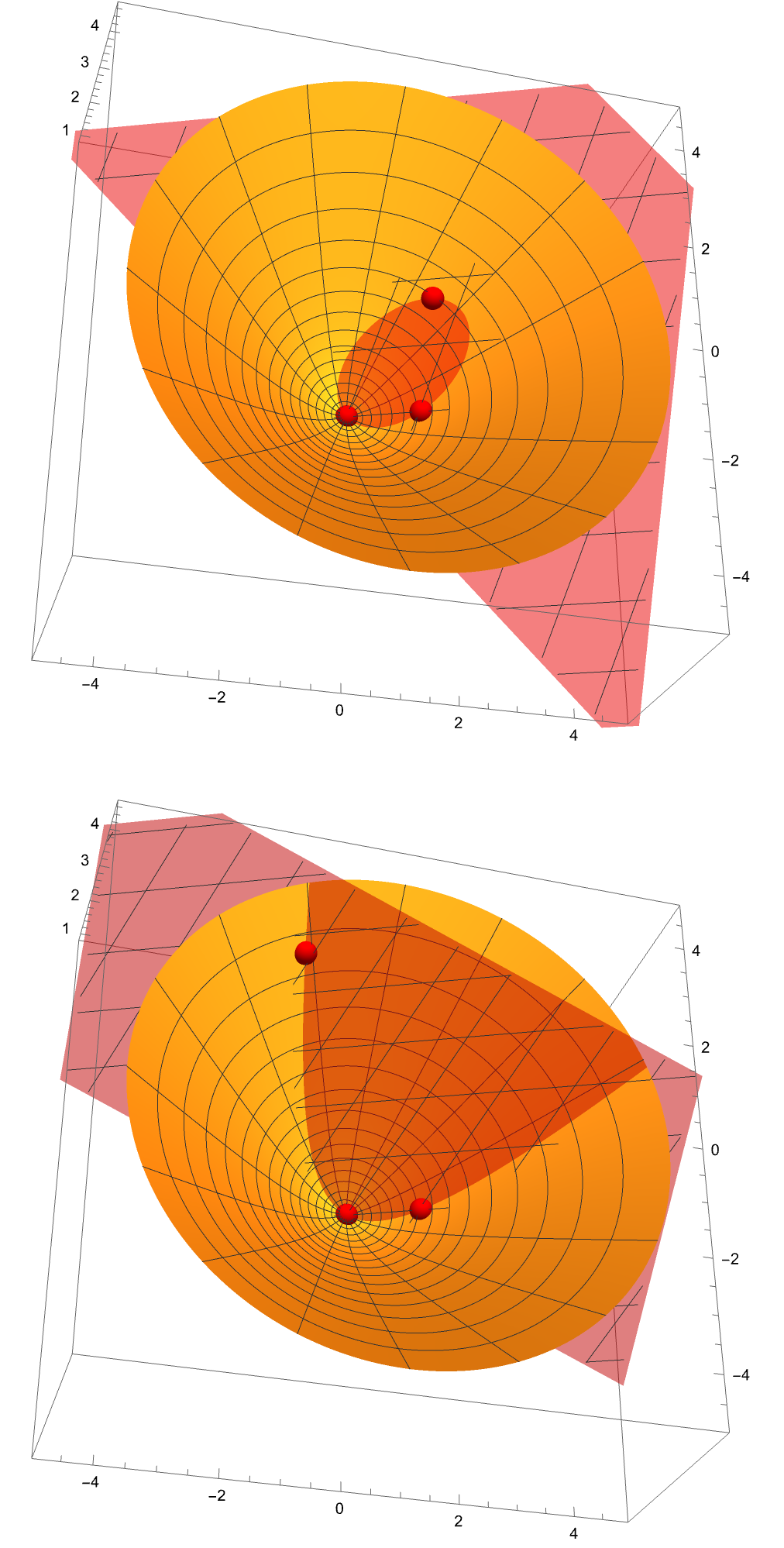
This is easiest to see if we model the hyperbolic plane as one surface of the hyperboloid −𝑡²+𝑥²+𝑦²=−1. The image shows 2 cases, where the plane through 3 points intersects the hyperboloid either in a closed curve or an open one, with the latter corresponding to a hypercycle.
If we pick 2 points at random in a disk in the hyperbolic plane with radius ρ around our 3rd point, what is the probability that those 3 points *will* lie on a circle?
This is:
\[ \frac{\text{csch}^4\left(\frac{\rho }{2}\right) \left(-30 \sinh \left(\frac{\rho }{2}\right)+2 \sinh
\left(\frac{3 \rho }{2}\right)+36 \tan ^{-1}\left(\tanh \left(\frac{\rho }{4}\right)\right)+3 \pi
\right)}{12 \pi }\]
-\[\frac{\left(\text{csch}^4\left(\frac{\rho }{2}\right)-4\right) \cos ^{-1}\left(1-2
\text{sech}^2\left(\frac{\rho }{2}\right)\right)}{4 \pi } \]
which starts at 1 for ρ=0, falls to about 3/4 at ρ=1, and approaches 0 as ρ→∞.
1