
The Oort cloud is a huge region of icy objects surrounding our Sun. We're not sure it exists, but we think that's where comets come from.
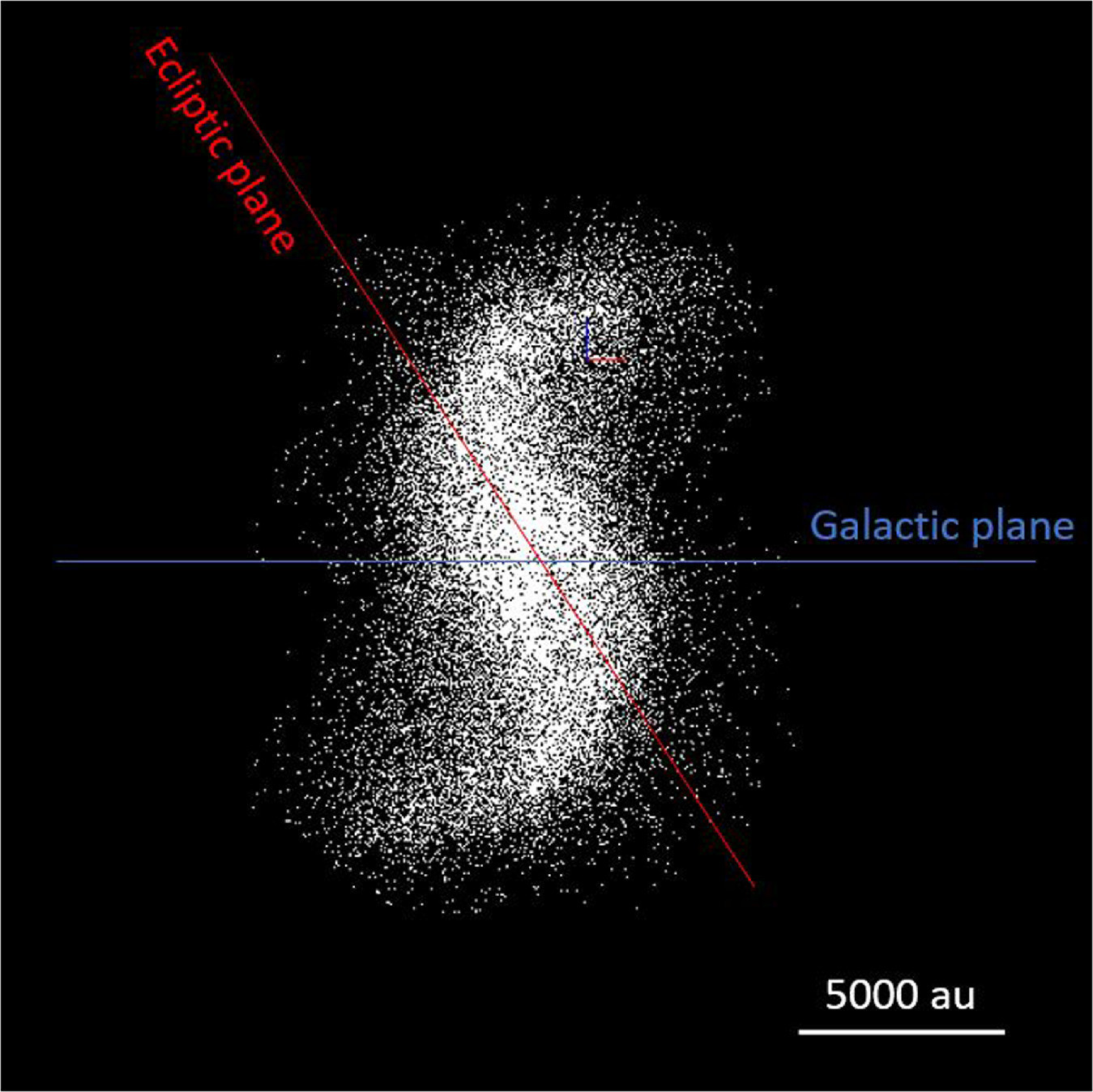
I've generally seen the Oort cloud drawn as a vague round blob. But recently some people simulated it - and discovered that tidal forces from the Milky Way would pull it into a much more interesting shape!
It actually looks like a cartoon of a galaxy! But it's poking up at right angles to the plane of our galaxy, drawn in blue here.
The red line indicates the plane that the planets mostly move around in, called the 'ecliptic'.
Let me paraphrase the paper:
According to our theories, the formation of the Oort cloud formation dates back to early stages of the solar system, about 4.6 billion years ago. First, as the outer planets cleared their orbital neighborhood, billions of small icy objects were pushed into very eccentric orbits that come as close as 30 AU to the Sun and as far as and as far as 1000 AU. (Remember, the Earth is 1 AU from the Sun.) Second, Galactic tidal forces slowly pulled these objects farther from the Sun and tilted their orbits. Third, encounters of the Sun with nearby stars mixed up the orbits of these Oort cloud objects.
In the end, the inner Oort cloud consists of objects 1000 to 10,000 AU from the Sun, and it looks like the picture. It's more or less flat, roughly 15,000 AU across, tilted 30° to the ecliptic, and it looks like a spiral with two twisted arms.
The spiral structure was first noticed when they showed this simulation in the Hayden Planetarium in preparation for a new space show!
https://iopscience.iop.org/article/10.3847/1538-4357/adbf9b
I've generally seen the Oort cloud drawn as a vague round blob. But recently some people simulated it - and discovered that tidal forces from the Milky Way would pull it into a much more interesting shape!
It actually looks like a cartoon of a galaxy! But it's poking up at right angles to the plane of our galaxy, drawn in blue here.
The red line indicates the plane that the planets mostly move around in, called the 'ecliptic'.
Let me paraphrase the paper:
According to our theories, the formation of the Oort cloud formation dates back to early stages of the solar system, about 4.6 billion years ago. First, as the outer planets cleared their orbital neighborhood, billions of small icy objects were pushed into very eccentric orbits that come as close as 30 AU to the Sun and as far as and as far as 1000 AU. (Remember, the Earth is 1 AU from the Sun.) Second, Galactic tidal forces slowly pulled these objects farther from the Sun and tilted their orbits. Third, encounters of the Sun with nearby stars mixed up the orbits of these Oort cloud objects.
In the end, the inner Oort cloud consists of objects 1000 to 10,000 AU from the Sun, and it looks like the picture. It's more or less flat, roughly 15,000 AU across, tilted 30° to the ecliptic, and it looks like a spiral with two twisted arms.
The spiral structure was first noticed when they showed this simulation in the Hayden Planetarium in preparation for a new space show!
https://iopscience.iop.org/article/10.3847/1538-4357/adbf9b
1