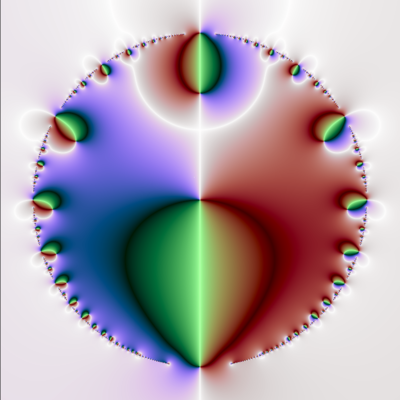
There are fascinating connections between the Riemann zeta function and music theory. I'll probably write a paper about this, but I can't resist talking about a little piece of the story. I will *not* explain what this has to do with music, since I want to tell that exciting story later on, and do a really good job of it.
Any commutative ring has a zeta function! The Riemann zeta function is the zeta function of ℤ, but the zeta function of ℤ/3 × ℤ/5 is simpler: it's just
1/(1 - 3⁻ˢ)(1 - 5⁻ˢ)
Let's graph this along the 'critical line' where the famous zeros of the Riemann zeta function live. So, let's take
s = ½ + ix
and plot
|1/(1 - 3⁻ˢ)(1 - 5⁻ˢ)|
as a function of x from x = 0 to x = 100. We get this picture here:
(1/n)
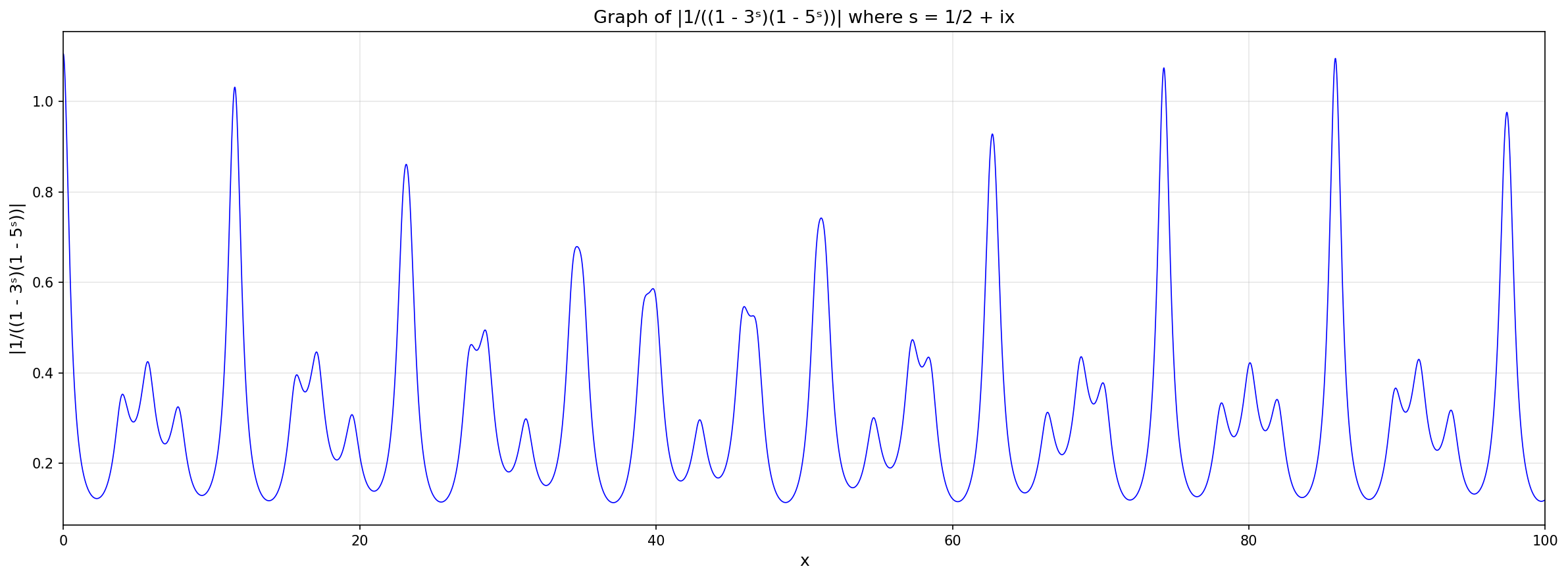
Any commutative ring has a zeta function! The Riemann zeta function is the zeta function of ℤ, but the zeta function of ℤ/3 × ℤ/5 is simpler: it's just
1/(1 - 3⁻ˢ)(1 - 5⁻ˢ)
Let's graph this along the 'critical line' where the famous zeros of the Riemann zeta function live. So, let's take
s = ½ + ix
and plot
|1/(1 - 3⁻ˢ)(1 - 5⁻ˢ)|
as a function of x from x = 0 to x = 100. We get this picture here:
(1/n)
43