
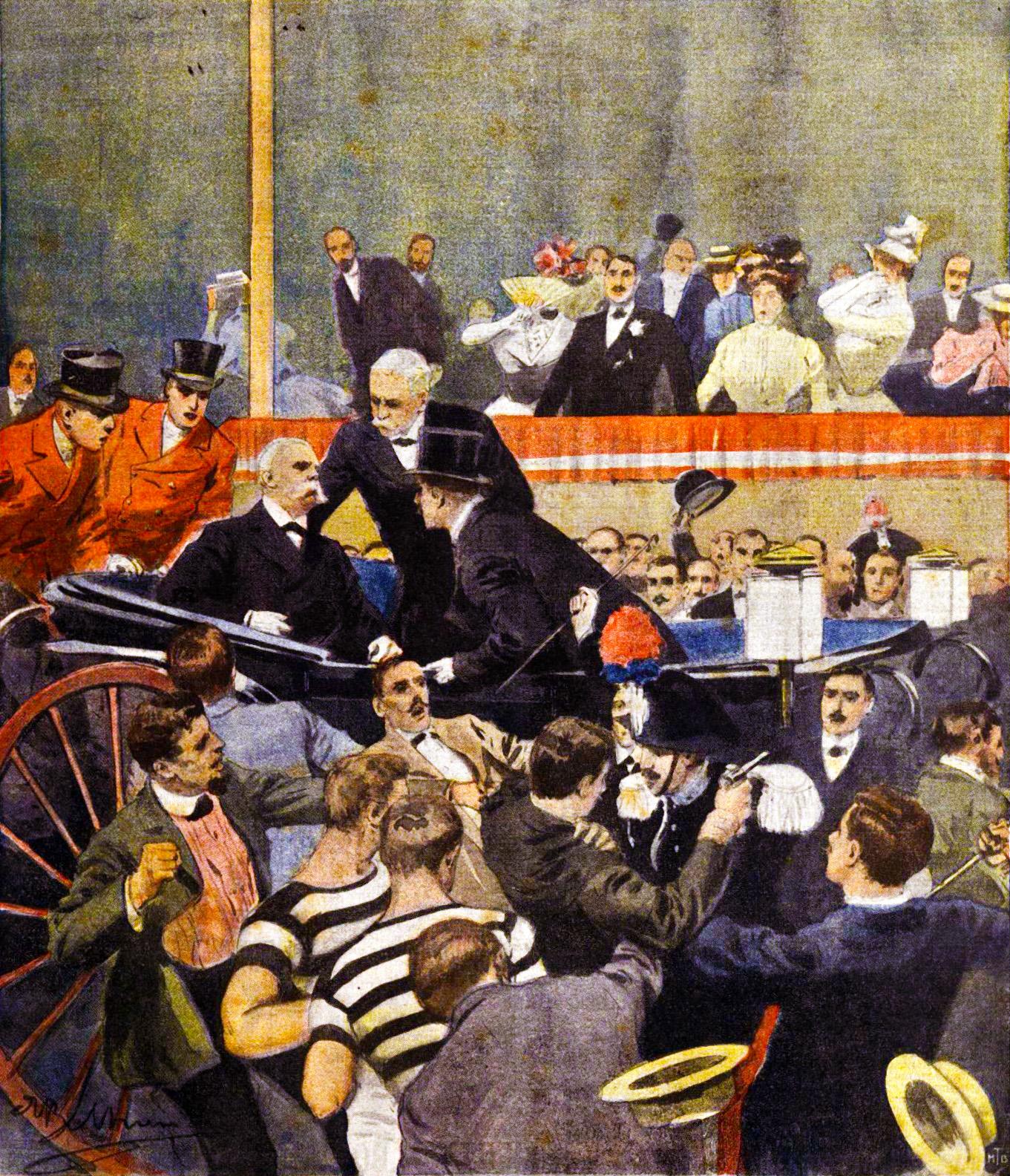
Today in Labor History July 29, 1900: Italian anarchist Gaetano Bresci assassinated King Umberto of Italy. He did it to avenge the scores of workers the army killed during the Milan insurrection of 1898, also known as the Bava Beccaris massacre. In that uprising, workers went on strike over high food prices. Police shot and killed a man, leading to riots in Milan, Florence, and Livorno. The government mustered over 45,000 soldiers. In Milan, 60,000 workers marched from the working-class suburbs to the city center to confront the troops. They built barricades and hurled stones and tiles at them from the rooftops. Some of the workers liberated firearms from local arms manufacturers. The troops were ordered to fire on the demonstrators, slaughtering up to 400 workers and wounding as many as 2,000.
Gaetano Bresci was radicalized and drawn to anarchism from a young age. He began working in a textile mill, in Italy, at the age of 15. In his early 20’s, he was arrested for insulting a police officer and later served time for organizing a textile strike. In 1897, he emigrated to the U.S., getting a job at a silk mill in Patterson, New Jersey. There he married an Irish-American woman and had two children. He joined the Right to Existence Group, and co-founded and wrote for its newspaper, La Questione Sociale. He once saved Errico Malatesta’s life by disarming an assassin who had shot Malatesta at one of the group’s meetings. News of the Bava Beccaris massacre motivated him to return to Italy to murder the king in retaliation. The authorities arrested Bresci. He was later found strangled in his cell at Santo Stefano Prison, on May 22, 1901. Anarchists regarded him as a martyr. His act of regicide inspired Leon Czolgosz to assassinate President McKinley.
#workingclass #LaborHistory #anarchism #atentat #assassination #mckinley #erricomalatesta #gaetanobresci #italy
Gaetano Bresci was radicalized and drawn to anarchism from a young age. He began working in a textile mill, in Italy, at the age of 15. In his early 20’s, he was arrested for insulting a police officer and later served time for organizing a textile strike. In 1897, he emigrated to the U.S., getting a job at a silk mill in Patterson, New Jersey. There he married an Irish-American woman and had two children. He joined the Right to Existence Group, and co-founded and wrote for its newspaper, La Questione Sociale. He once saved Errico Malatesta’s life by disarming an assassin who had shot Malatesta at one of the group’s meetings. News of the Bava Beccaris massacre motivated him to return to Italy to murder the king in retaliation. The authorities arrested Bresci. He was later found strangled in his cell at Santo Stefano Prison, on May 22, 1901. Anarchists regarded him as a martyr. His act of regicide inspired Leon Czolgosz to assassinate President McKinley.
#workingclass #LaborHistory #anarchism #atentat #assassination #mckinley #erricomalatesta #gaetanobresci #italy