

A theorem you'll never forget: Napoleon's theorem.
Take any triangle. Erect equilateral triangles on its three sides. The centers of these triangles are the vertices of another equilateral triangle!
While traditionally attributed to Napoleon, who *was* interested in geometry, there's no good evidence that he proved it. In reality, this result first appears in 𝘛𝘩𝘦 𝘓𝘢𝘥𝘪𝘦𝘴' 𝘑𝘰𝘶𝘳𝘯𝘢𝘭 in 1824, posed as a puzzle by one "Mr. W. Rutherford of Woodburn". This guy is famous for having computed pi to 208 digits... of which only the first 152 were correct.
The proof here claims to be "geometrical" but is strategy is algebraic:
https://www.slideserve.com/hogan/a-geometric-proof-of-napoleon-s-theorem
Find a formula for the length of one side of the would-be equilateral triangle that depends symmetrically on the lengths of all 3 sides of the original triangle. This implies all sides of the would-be equilateral triangle have the same length. So it's indeed equilateral!
Napoleon's theorem has an excellent generalization to n-gons: the Napoleon-Barlotti theorem. The centers of regular n-gons constructed over the sides of an n-gon P form a regular n-gon if and only if P is an affine image of a regular n-gon! Roughly speaking, this means P is a regular n-gon that's been stretched or squashed or sheared in a linear way.
Since every triangle is an affine image of an equilateral triangle, this reduces to Napoleon's theorem when n = 3. ✔️
I wonder how Barlotti felt about sharing a result with the Emperor of the French.
(1/2)
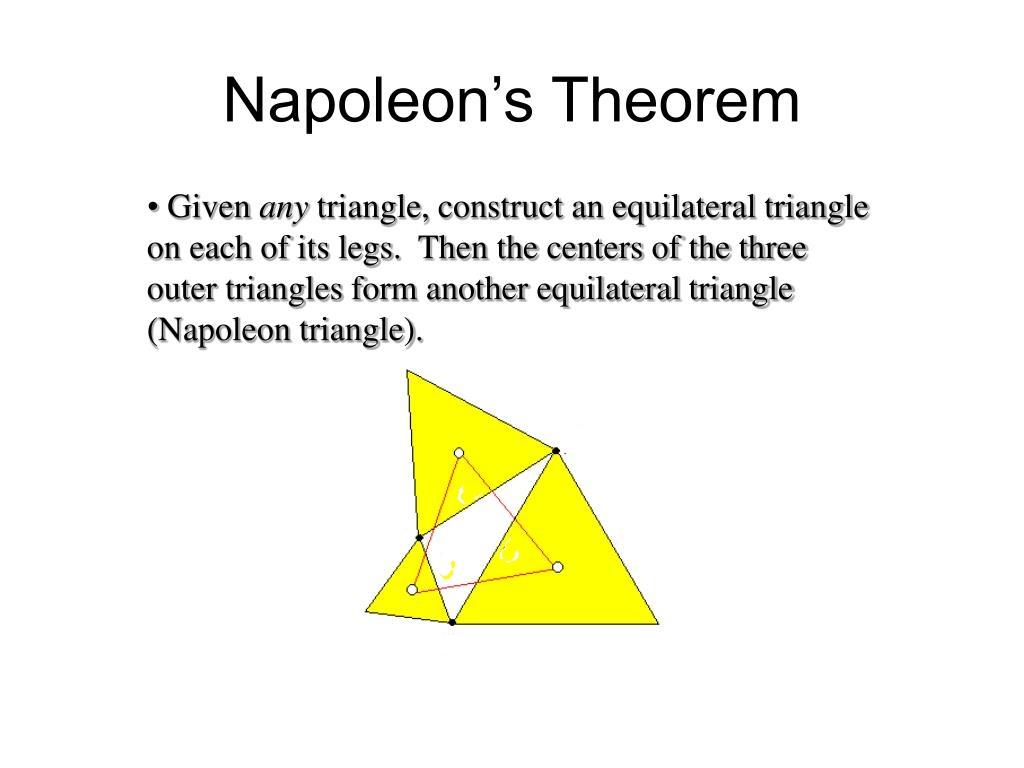
Take any triangle. Erect equilateral triangles on its three sides. The centers of these triangles are the vertices of another equilateral triangle!
While traditionally attributed to Napoleon, who *was* interested in geometry, there's no good evidence that he proved it. In reality, this result first appears in 𝘛𝘩𝘦 𝘓𝘢𝘥𝘪𝘦𝘴' 𝘑𝘰𝘶𝘳𝘯𝘢𝘭 in 1824, posed as a puzzle by one "Mr. W. Rutherford of Woodburn". This guy is famous for having computed pi to 208 digits... of which only the first 152 were correct.
The proof here claims to be "geometrical" but is strategy is algebraic:
https://www.slideserve.com/hogan/a-geometric-proof-of-napoleon-s-theorem
Find a formula for the length of one side of the would-be equilateral triangle that depends symmetrically on the lengths of all 3 sides of the original triangle. This implies all sides of the would-be equilateral triangle have the same length. So it's indeed equilateral!
Napoleon's theorem has an excellent generalization to n-gons: the Napoleon-Barlotti theorem. The centers of regular n-gons constructed over the sides of an n-gon P form a regular n-gon if and only if P is an affine image of a regular n-gon! Roughly speaking, this means P is a regular n-gon that's been stretched or squashed or sheared in a linear way.
Since every triangle is an affine image of an equilateral triangle, this reduces to Napoleon's theorem when n = 3. ✔️
I wonder how Barlotti felt about sharing a result with the Emperor of the French.
(1/2)