
With oil getting expensive, and looking to only become more and more expensive, I've been doing a little bit of research on electric cars lately. Here are some of the things I've found:
1. Gasoline engines are about 30% efficient (diesels about 40%). Gasoline has 36 kWh/gallon of chemical energy, so a gasoline engine makes about 11 kWh/gallon.
2. If you pay 20 cents per kWh then that equals $2.20/gallon-equivalent (just multiply your price per kWh by 11 to get gasoline gallon equivalent price) - if you're paying more than that for gasoline, it's cheaper to drive electric.
3. Battery capacity is indeed quite small, a 100kWh battery used in Teslas is one of the biggest, and that's ONLY equivalent to about a 10 gallon tank. And most batteries are 30-60Kwh... That's why everyone speaks in terms of miles of range.
4. From range and capacity, you can deduce equivalent MPG. One Tesla Model S declares 240 miles of range for a 70 kWh battery, that divides to 3.43 miles per kWh, or 37.7 MPG.
5. Early on, there was a lot of fear that battery degradation would bound the lifetime of EVs to about 5 years. We all have experiences with laptops and phones from the 2000s and 2010s which the batteries degraded to the point that they would not even hold 1 minute worth of charge. The good news is this fear turned out to be unfounded. Improved battery chemistries and active cooling has more or less solved this problem, and degradation in EVs is slow and well understood.
6. Not all EVs are alike. As with ICE vehicles, some are quite decent, others are best avoided. With ICE vehicles, there are well known disasters such as Wet Belts, CVT Transmissions, or the Hyundai Theta II engine. With EVs, the problem is less about catastrophic failure and more about oddball designs where replacement parts are rare and expensive, or are simply too difficult to work on. EVs are somewhat unique in that some of them were made in extremely small production runs and in that case, there are few in junk yards and repair parts are in short supply.
7. Not all EVs are alike. Every modern car is locked down to some extent in order to make it more difficult to repair. With EVs as with ICE cars, some of the more popular platforms have been reverse engineered and have a decent aftermarket. So every car platform has two variables: How anti-repair it is made from the factory, and how well has it been reverse-engineered. Tesla is very repair-hostile, but has a large community that has figured a lot of things out. The Nissan Leaf is a fair bit less hostile, and also has a large community and even has aftermarket / Frankenstein battery packs that some people build.
8. Not all EVs are alike. Big dumb touchscreens, and doors that don't open without electricity so you can't get out in a crash are not obligatory. Be smart.
9. The best EVs seem to be the ones which started being made a long time ago (plenty of time to work out the bugs), and are made in large number, by stable car companies w/o financial problems. Chevrolet Bolt and Nissan Leaf seem to be fairly good - do your own research of course.
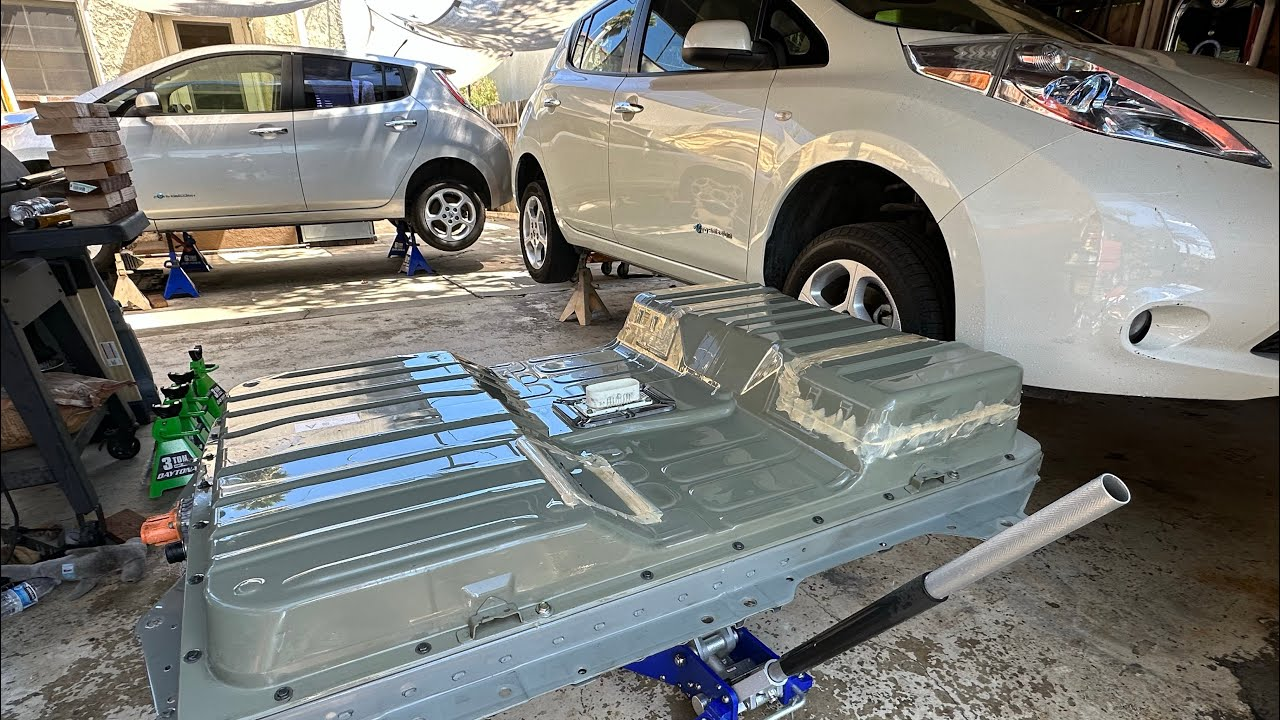
10. Electric motors are more or less bulletproof, so in an EV, the only part that you really need to worry about is the battery pack. Most EV battery packs are removable (WARNING: NOT ALL). They are very heavy so you need jacks to get them out, but once they're out they can be repaired on a workbench.
11. You can usually buy second-hand batteries out of a junk yard (check this before buying a car!). This is the most common way batteries are swapped. You can also (depending on the car) go into the battery pack and do repairs or cell replacement. This is quite dangerous as you're dealing with a uniquely deadly combination of high voltage, and insanely high available amperage - and there's no way to "cut power" because inside of the battery IS the power. So some shops will be happy to swap batteries but unwilling to open them, even if the only thing that failed is a small relay.
10. If you're looking at used EVs, you want to know State of Health (SOH) and voltage difference between cells. Different voltage between cells is a sign of failing cells. If this isn't available in the on-board computer, take it to a shop that does EVs and have them pull the numbers before buying.
11. EV owners often do not charge to 100% because filling all the way degrades the battery faster. There is a setting in the onboard computer to make the car stop charging at 90% or 80%. There is LOTS of advice online about this, reality depends on your battery chemistry. Most EVs are NMC (Nickel Manganese Cobalt) batteries, some newer ones are LFP (Lithium Iron Phosphate).
12. Battery fires are another problem that is more-or-less solved, UNLESS, you are in a serious accident that punctures the battery. NMC batteries are known to burn, LFP are much safer in that regard, new/experimental chemistries are being developed which will not burn at all but we're not there yet.
13. EVs do not wear out the same way as ICE vehicles (!!!!) In an ICE vehicle you look at the miles on the odometer to see how worn out it is. A 50 year old car with 20,000 miles is "brand new" as long as it lived its life in a garage. Batteries wear just from sitting, so calendar years on a battery matter, even if it was rarely ever driven in those years. On top of that, EVs from the earlier years had more teething issues, so newer models are often a better choice. In the case of the Leaf, pre-2016 models had a design flaw that cause excessive battery degradation, from 2016 through 2019 quality continuously improved, then after 2020 it became more variable with some QC issues popping up. This kind of "good years and bad years" thing is typical of all models, Do Your Research.
I think that's about everything... Let me know if there's anything you're curious about that I didn't mention.
1. Gasoline engines are about 30% efficient (diesels about 40%). Gasoline has 36 kWh/gallon of chemical energy, so a gasoline engine makes about 11 kWh/gallon.
2. If you pay 20 cents per kWh then that equals $2.20/gallon-equivalent (just multiply your price per kWh by 11 to get gasoline gallon equivalent price) - if you're paying more than that for gasoline, it's cheaper to drive electric.
3. Battery capacity is indeed quite small, a 100kWh battery used in Teslas is one of the biggest, and that's ONLY equivalent to about a 10 gallon tank. And most batteries are 30-60Kwh... That's why everyone speaks in terms of miles of range.
4. From range and capacity, you can deduce equivalent MPG. One Tesla Model S declares 240 miles of range for a 70 kWh battery, that divides to 3.43 miles per kWh, or 37.7 MPG.
5. Early on, there was a lot of fear that battery degradation would bound the lifetime of EVs to about 5 years. We all have experiences with laptops and phones from the 2000s and 2010s which the batteries degraded to the point that they would not even hold 1 minute worth of charge. The good news is this fear turned out to be unfounded. Improved battery chemistries and active cooling has more or less solved this problem, and degradation in EVs is slow and well understood.
6. Not all EVs are alike. As with ICE vehicles, some are quite decent, others are best avoided. With ICE vehicles, there are well known disasters such as Wet Belts, CVT Transmissions, or the Hyundai Theta II engine. With EVs, the problem is less about catastrophic failure and more about oddball designs where replacement parts are rare and expensive, or are simply too difficult to work on. EVs are somewhat unique in that some of them were made in extremely small production runs and in that case, there are few in junk yards and repair parts are in short supply.
7. Not all EVs are alike. Every modern car is locked down to some extent in order to make it more difficult to repair. With EVs as with ICE cars, some of the more popular platforms have been reverse engineered and have a decent aftermarket. So every car platform has two variables: How anti-repair it is made from the factory, and how well has it been reverse-engineered. Tesla is very repair-hostile, but has a large community that has figured a lot of things out. The Nissan Leaf is a fair bit less hostile, and also has a large community and even has aftermarket / Frankenstein battery packs that some people build.
8. Not all EVs are alike. Big dumb touchscreens, and doors that don't open without electricity so you can't get out in a crash are not obligatory. Be smart.
9. The best EVs seem to be the ones which started being made a long time ago (plenty of time to work out the bugs), and are made in large number, by stable car companies w/o financial problems. Chevrolet Bolt and Nissan Leaf seem to be fairly good - do your own research of course.
10. Electric motors are more or less bulletproof, so in an EV, the only part that you really need to worry about is the battery pack. Most EV battery packs are removable (WARNING: NOT ALL). They are very heavy so you need jacks to get them out, but once they're out they can be repaired on a workbench.
11. You can usually buy second-hand batteries out of a junk yard (check this before buying a car!). This is the most common way batteries are swapped. You can also (depending on the car) go into the battery pack and do repairs or cell replacement. This is quite dangerous as you're dealing with a uniquely deadly combination of high voltage, and insanely high available amperage - and there's no way to "cut power" because inside of the battery IS the power. So some shops will be happy to swap batteries but unwilling to open them, even if the only thing that failed is a small relay.
10. If you're looking at used EVs, you want to know State of Health (SOH) and voltage difference between cells. Different voltage between cells is a sign of failing cells. If this isn't available in the on-board computer, take it to a shop that does EVs and have them pull the numbers before buying.
11. EV owners often do not charge to 100% because filling all the way degrades the battery faster. There is a setting in the onboard computer to make the car stop charging at 90% or 80%. There is LOTS of advice online about this, reality depends on your battery chemistry. Most EVs are NMC (Nickel Manganese Cobalt) batteries, some newer ones are LFP (Lithium Iron Phosphate).
12. Battery fires are another problem that is more-or-less solved, UNLESS, you are in a serious accident that punctures the battery. NMC batteries are known to burn, LFP are much safer in that regard, new/experimental chemistries are being developed which will not burn at all but we're not there yet.
13. EVs do not wear out the same way as ICE vehicles (!!!!) In an ICE vehicle you look at the miles on the odometer to see how worn out it is. A 50 year old car with 20,000 miles is "brand new" as long as it lived its life in a garage. Batteries wear just from sitting, so calendar years on a battery matter, even if it was rarely ever driven in those years. On top of that, EVs from the earlier years had more teething issues, so newer models are often a better choice. In the case of the Leaf, pre-2016 models had a design flaw that cause excessive battery degradation, from 2016 through 2019 quality continuously improved, then after 2020 it became more variable with some QC issues popping up. This kind of "good years and bad years" thing is typical of all models, Do Your Research.
I think that's about everything... Let me know if there's anything you're curious about that I didn't mention.
6