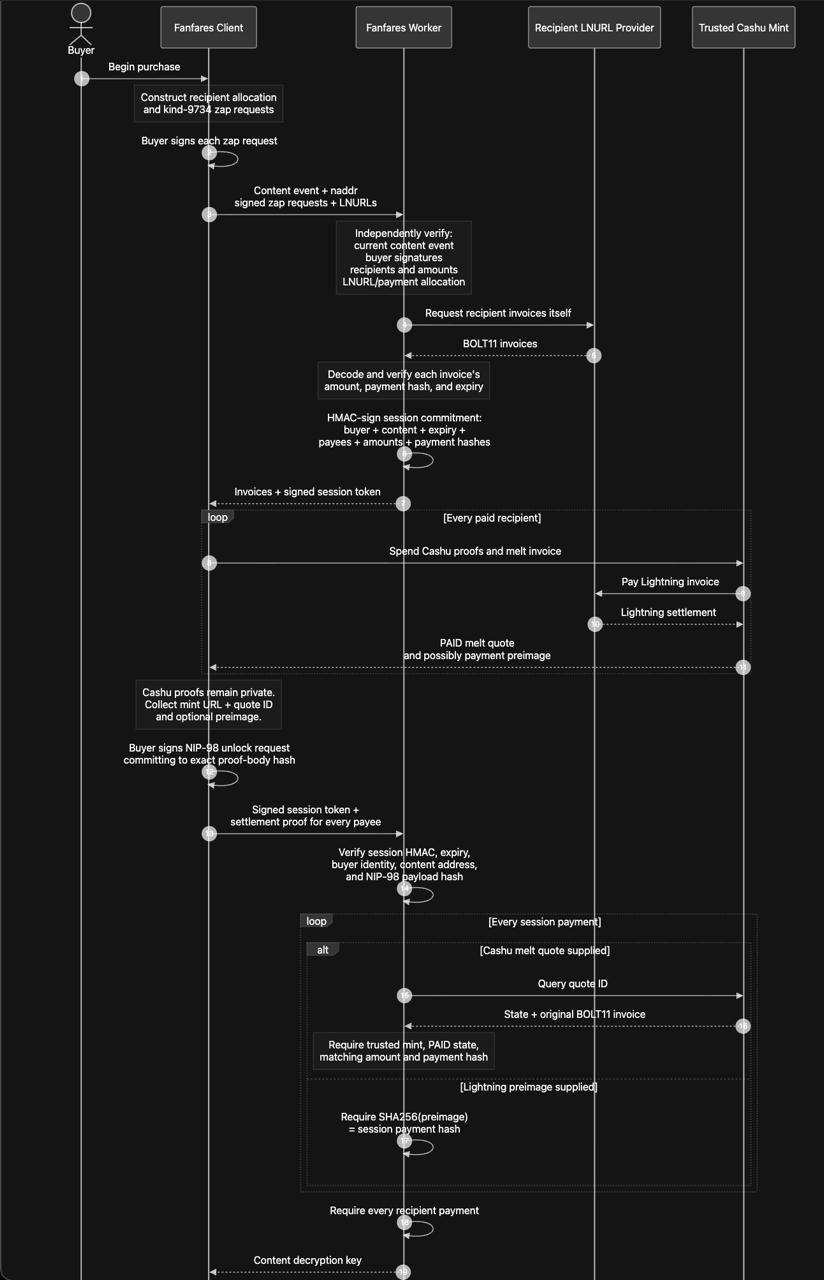
This image is slightly outdated, but it’s still a good representation of how our payment verification works, including built-in splits and referrals.
Think of it like signing a contract with our tiny backend before paying for an event. It attests what you’re purchasing and sends back a signed contract. After payment, you provide proof that the token was spent. We cross-check that against the contract, and if everything matches, you get the decryption key.
We’re also experimenting with open web-of-trust systems, particularly those being built by the Nostr community. We’re open to letting authors decide which mints they trust, and our system can adapt around that.
There’s also a key recovery mechanism if a key gets leaked. It’s still being developed, but it already works. Key derivation itself is deterministic based on the event, its author, and a specialized tag, while our backend only holds half of the secret.
Eventually, we want to expose all of this through an API so paid content can be integrated across applications. And what if that API could be self-hosted on a $2.50 ESP32?
We know we’ll make mistakes and there will be trade-offs along the way, but we’ll do our best. Feel free to ask me anything about it.