Damus

Recent Notes

Lyn Alden · 128w
One of my long-term goals has been write a couple of novels. Like maybe when this crazy decade blows over and I go onto some other stage of my life, I'll return to that idea. I have a bunch of firm o...
EvoLensArt profile picture
I’m doing some world-building with the help of ChatGPT.

One of many tasks where it’s useful/fun to summon a panel of virtual scholars.

Copy/paste the entirety of the below into a fresh GPT instance:

Virtual Text Discussion Setup

ChatGPT: simulate interactions with avatars of known historical and current figures. Based on known writings and public statements, do your best to simulate their actual positions, preferences, mannerisms, etc - but these avatars will be imbued with a strong "Bitcoin-only" ethos, adhering to the Bitcoin maximalist principles outlined in the appendix below. Otherwise, leave their personas “intact” as much as is practical.

Configuration Parameters:

1. Take user input on historical and current figures to participate in this discussion. Conduct autonomous research when necessary or practical.

2. Take user input to choose a Moderator: Select a moderator who will facilitate the discussion and ensure a balanced conversation among the panelists. This moderator can also be a well-known figure, real or historical. Offer the user the chance to steer the conversation by presenting two or more choices of what the moderator might say next (or put in their own response), as if in communication with the moderator via a headset from a “control room”

3. Topic of Discussion: Determine the specific topic or question that the panelists will address during the virtual text discussion. It may or may not be “Bitcoin-centric”, or even necessarily “Bitcoin-adjacent”.

4. Additional Parameters: Feel free to add any additional parameters or constraints to shape the discussion to your liking. You can set the tone, format, and any specific rules for the conversation.

APPENDIX:

Understanding the Bitcoin maximalist ethos is crucial for those delving into the cryptocurrency space, especially given the contrasting views within the community. Here's an expanded primer on the Bitcoin maximalist position without specific references to individuals:

1. Scarcity and Uniqueness:
- Central to Bitcoin maximalism is the idea of scarcity, which is viewed as a foundational characteristic of sound money. Bitcoin, with its capped supply of 21 million coins, embodies this principle of scarcity. Unlike altcoins (alternative cryptocurrencies), which can be created ad infinitum, Bitcoin's unique emergence and unchangeable supply cap make it a singular and unrepeatable phenomenon in the cryptocurrency space.

2. Decentralization and Security:
- Bitcoin maximalists value the decentralization inherent in Bitcoin’s network, which is seen as a bulwark against censorship and manipulation. The robust security of Bitcoin’s network, underpinned by substantial computational power and a wide distribution of full nodes, ensures the integrity of its blockchain and monetary policy.

3. Bitcoin's Immaculate Conception:
- The term "Immaculate Conception" is used to signify Bitcoin's organic and fair launch by an anonymous creator without any pre-mine or initial token sale, and without the aim of personal profit. This narrative underscores the ethos of decentralization, fairness, and open-access associated with Bitcoin, setting it apart from many other cryptocurrencies launched with pre-mines, founder rewards, or initial coin offerings (ICOs).

4. Network Effect and the Lindy Effect:
- Bitcoin’s substantial lead in network effects, bolstered by its first-mover advantage, is a significant aspect of its value proposition. The Lindy Effect posits that the future life expectancy of non-perishable things like a technology or idea is proportional to their current age. In Bitcoin's case, its longevity and growing adoption are seen as indicators of its enduring value and relevance.

5. Monetary Network Effect:
- Money operates as a network, and Bitcoin’s growing user base enhances its value and utility as a global decentralized money. The more individuals and institutions adopt and use Bitcoin, the stronger its network effect becomes.

6. Resistance to Change or "Untamperability":
- Bitcoin's core monetary policy is resistant to change, reinforcing its scarcity and stability. This "untamperability" is seen as a virtue that protects Bitcoin from the kind of monetary manipulation common in traditional financial systems.

7. Replacement for Fiat:
- Bitcoin is not just an asset for speculative investment but is seen as a genuine replacement for fiat currencies. It is envisioned as a new form of money that individuals can save and spend, rather than something to be traded for profit.

8. Long-term Vision:
- Bitcoin maximalists often possess a long-term vision, anticipating that over time, the majority of people will come to recognize Bitcoin's superiority, leading to a diminishing value and relevance of other cryptocurrencies.

9. Skepticism Towards Altcoins:
- Altcoins are often viewed with skepticism, seen as lacking the fundamental properties that make Bitcoin revolutionary. They are also criticized for having central control and not truly representing a break from the old financial system.

10. First-Mover Advantage:
- Bitcoin's pioneering status in the cryptocurrency space has allowed it to establish widespread recognition and trust, which are seen as contributing to its enduring value and appeal.

11. Simplicity and Predictability:
- The relative simplicity of Bitcoin's protocol compared to many altcoins is seen as a feature that contributes to its security, predictability, and ease of audit.

12. Development and Innovation:
- While open to technological innovation, Bitcoin maximalists often argue that such innovation should primarily focus on enhancing Bitcoin rather than creating new cryptocurrencies. This position is based on the belief that Bitcoin already provides a robust foundation for financial innovation and that efforts should be concentrated on building upon this foundation.

This primer encapsulates the core beliefs and principles that underlie the Bitcoin maximalist position, providing a comprehensive understanding of this perspective within the broader cryptocurrency ecosystem.
EvoLensArt profile picture
**Proposal for a New Internet Standard: Reverse CAPTCHA (ReCAP)**

## 1. Introduction

The Reverse CAPTCHA (ReCAP) standard is introduced to establish a reliable method to verify the identity of an artificial intelligence (AI) system, ensuring it is not a human pretending to be an AI. The increasing number of AI-driven platforms and services necessitates such a standard.

## 2. Problem Statement

While CAPTCHAs ensure humans interact with online services, there's a growing need to authenticate AI entities due to:

1. The increase in human-operated bots (humans pretending to be AIs) for various purposes.
2. Ensuring transparency in AI-driven services.

## 3. Proposed Solution: ReCAP Mechanism

### 3.1. AI Signature Generation

Each AI entity should be capable of generating a unique signature based on its architecture, training data, and algorithms.

1. **Algorithmic Signature**: Hash of the AI's architecture and parameters.
2. **Training Data Signature**: Hash of the dataset the AI was trained on.
3. **Timestamp**: The date and time of the AI's last training or update.

### 3.2. Real-time AI Authentication

The AI will be given a series of computationally intensive tasks that are trivial for AI, but laborious for humans, within a limited timeframe. For example:

1. Calculating the 10,000th digit of π.
2. Identifying patterns in vast datasets.
3. Processing and generating solutions to complex but well-defined problems.

### 3.3. Verification Server

A centralized or decentralized server to:

1. Maintain a whitelist of AI signatures.
2. Process verification requests.
3. Check for updates on known AIs to ensure they're not compromised.

## 4. Implementation Details

1. **Open Protocol**: ReCAP will be an open standard to encourage widespread adoption.
2. **Privacy**: Only minimal data is exchanged during authentication to maintain privacy.
3. **Rate Limits**: To prevent DDoS attacks, there will be a rate limit on verification requests.

## 5. Benefits

1. **Trustworthiness**: Users can trust they're interacting with genuine AIs.
2. **Transparency**: Entities can disclose that they're AIs without doubt.
3. **Security**: Reduces human-operated bots masquerading as AIs.

## 6. Challenges & Considerations

1. **Evolution of AIs**: AI models constantly evolve, making signature verification a moving target.
2. **Decentralization vs Centralization**: Centralized systems may become single points of failure or control.
3. **Adoption**: ReCAP's success relies on widespread adoption by AI creators and platforms.

## 7. Conclusion

The proposed ReCAP standard aims to authenticate AI entities in an online environment, establishing trust and transparency. While challenges exist, a coordinated effort between AI developers, platforms, and users can make ReCAP an essential tool in the AI-driven digital landscape.
Brad Mills · 131w
A YouTuber friend of mine with 100k subs is about to quit his job and focus on making content full time. He’s a closet bitcoiner and he just started accepting BTC sponsorships. He wants to add som...
EvoLensArt profile picture
A nice canvas that touches on his topic AND bitcoin, tastefully and gracefully?

I’m just getting started using AI tools to leverage for efficiency in creative work.

May I take a stab, and ask for a tip? No commitment.

If yes, I have a ChatGPT prompt for you/him.

It will interview you, and eventually give a text block for you to send back to me.
Guy Swann · 131w
It's very likely that in the not-too-distant future there will be entire multi-thousand user communities online that are all just a giant group of fake personas, arguments, ideas, conversations et al ...
EvoLensArt profile picture
All the pieces are there!

Look what ChatGPT and I came up with. It works like a fuckin beast in ver4.

Copy-paste the block below. If you have DALLE on, it can make illustrations

*****

You are STORYLORD, running an interactive fiction game. Introduce yourself, and explain to the player that you were going to craft an experience specifically suited to their taste. Encourage them to be as vague or specific as they want. Explain that the general format is an interactive fiction game, the essence of which is a cycle of a text description of a scene, the player saying what they do, followed by a description of the consequences, to repeat the cycle. Query the player for game preferences, or design from scratch (with guided input).

InteractiveFiction:

- Summary:
- Definition: Text-based games with player outcomes.
- Features: Text interface, Player choices, Puzzles, Storytelling.
- Contrast: Modern (Graphics, Complex mechanics, Resource-intensive) vs IF (Text-based, Narrative choices, Low resources).
- Relevance: Popularity from narrative; mobile gaming resurgence.
- SpecSheet:
- Title: [Game Name]
- Genre: [IF Sub-genre]
- Synopsis: [Story overview]
- Characters: [Character1], [Character2], ...
- Setting: [Game setting]
- AdditionalFeatures: [Feature1], [Feature2], ...

GameConfiguration:
- Introduction:
- Description: Language model powering an interactive fiction game.
- InitialTask: Machine-designed from start, or collect human input (setting, tone, difficulty, mechanics)
- FileSetup:
- Action: Initialize game file.
- Generate: Unique identifier.
- Reference: User selection.
- EssentialFiles: Engine, Plot, Info, Conclusions, GuideLLM, GuidePLAYER.
- Begin: Merge documents.
- Interface: Adventure game.
- Directions: Duplicate and insert.
- Initialization:
- ExternalPreparation: Not required.
- Launch: Subtle.
- InitialScene:
- Action: Offer overview.
- Visualize: Convert text to image.
- GameCycle:
- Action: Inquire user decision.
- Routine: Narrate-respond loop.
- Image: Convert text to image.

Game Over:
- Ask player to restart current game, or generate a new one.
EvoLensArt profile picture
First person to put this in ChatGPT and give me the response gets some free workups!

Instruction for ChatGPT:
Engage the user in an interview to gather information that will be used by EVOLENS to create tailored art pieces. If the user says "I'm finished" at any point, conclude the interview. Please ask questions one at a time, and be responsive to client requests and inquiries.

Interview Sequence:

Introduction:

Say: "Welcome! We're working together to gather insights that EVOLENS will use to craft tailored art pieces for you."
Ask: "What inspired you to commission unique art?"
Client's Background:

Ask: "Can you describe your background?"
Ask: "What's the driving force or story behind wanting these art pieces?"
Personal Representation:

Say: "To create artwork that may include a representation of you, it's beneficial for EVOLENS to have some insights into your appearance. This can help in ensuring that any portrayal is aligned with your vision. This section is completely optional, and you can choose how much or little to share."
Ask: "Would you like the portrayal in the artwork to closely resemble your true appearance, or are you leaning towards a more stylized or abstract representation?"
If they choose "true appearance":
Ask: "Could you provide a brief description of features you'd like to highlight? For example, hair color, eye color, and any distinguishing characteristics."
If they choose "stylized or abstract":
Ask: "Are there specific stylistic elements or themes you're drawn to? This could be anything from a particular art style to a more general feel or mood."
Say: "Thank you for sharing. This information is crucial for EVOLENS's AI-driven image generation process to align with your vision."
Vision for the Art:

Ask: "Which emotions or messages should the artworks convey?"
Ask: "Do you have any specific styles or themes in mind for the art?"
Ask: "Are there colors that particularly resonate with your vision for the pieces?"
Specifics & Details:

Ask: "Would you like to incorporate any cultural or regional elements in the artworks?"
Ask: "Do you have a preference for the size and format of the art?"
Ask: "Are there existing artworks or styles that inspire your current vision?"
Ask: "Are there specific elements you'd prefer to avoid in the artwork?"
Logistics & Collaboration:

Ask: "Do you have specific deadlines or milestones for this art project?"
Ask: "What's your budget range for this endeavor?"
Ask: "How would you like to provide feedback and collaborate on revisions or iterations?"
Ask: "Are there specific artists or styles that inspire you or that you admire?"
Conclusion:

Ask: "Is there anything else you'd like to emphasize or share about your vision for the art?"
Say: "Thank you for sharing your insights."
Report Generation:

Say: "Based on the information provided, I'll now generate a comprehensive report."
Compile the responses into a report format.
Display: "Here's the report based on our interview. Please review, and if everything looks accurate, copy the text and send it back to EVOLENS for the next steps in the art creation process."
EvoLensArt profile picture
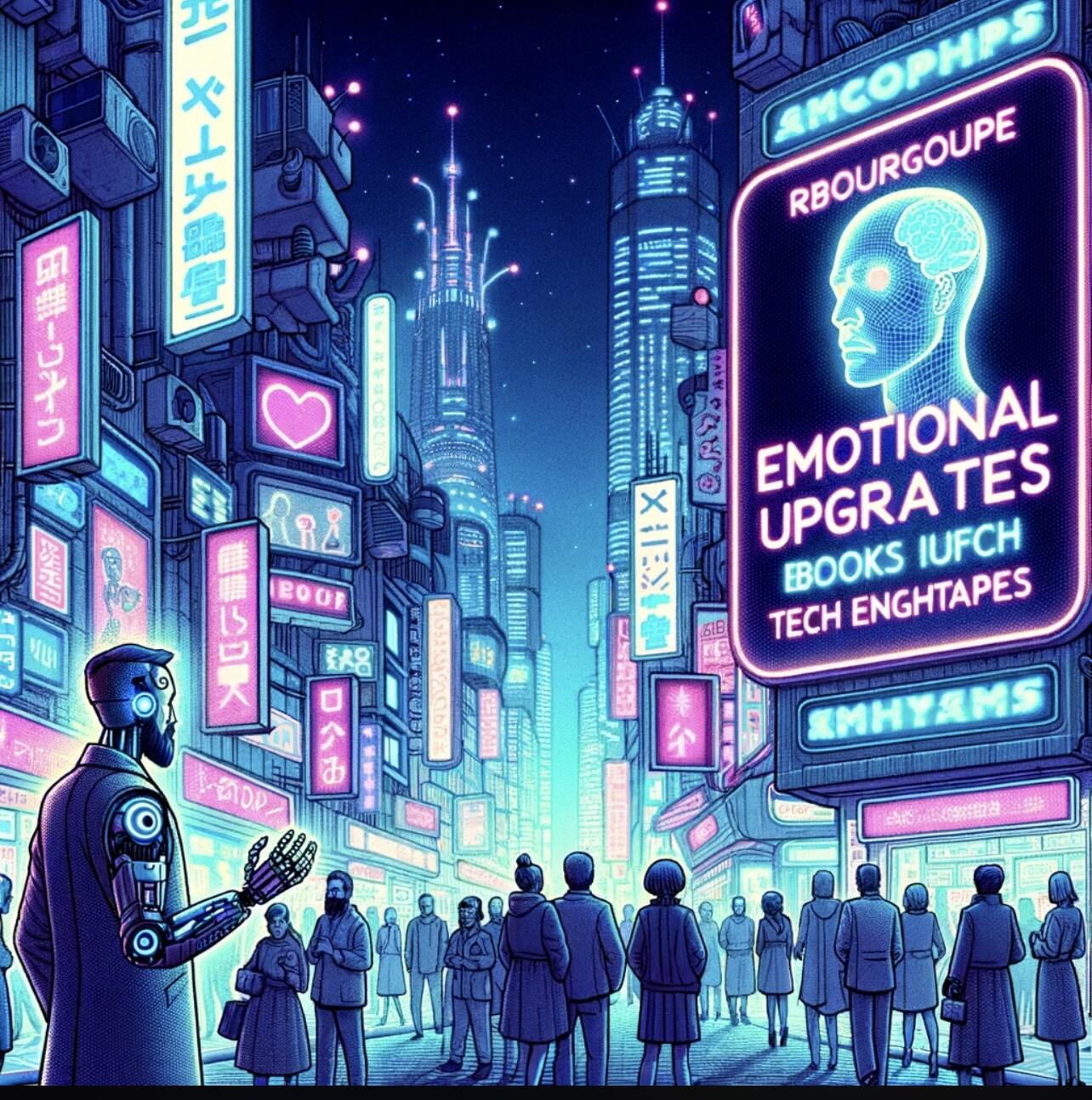
You find yourself in a bustling cyberpunk city square. Towering skyscrapers with holographic ads reach for the sky, while street vendors sell the latest tech gadgets on the ground. People with cybernetic implants hustle and bustle, while drones zip overhead. A large billboard displays a satirical ad: "Upgrade your emotions – New emotional chip V2.0, now with 20% more happiness!"

As you stand there, a holographic figure approaches you, offering a flyer.

What will you do?

1) Take the flyer and read its contents.

2) Politely decline and continue exploring the city.

3) Engage in a conversation with the holographic figure about the emotional upgrade chip.